That shift just took a concrete step as US drone specialist Saildrone and defence giant Lockheed Martin agreed to arm long‑range unmanned surface vessels with guided missiles, fusing cheap robotic platforms with weapons usually reserved for crewed warships.
A quiet research vessel gets teeth
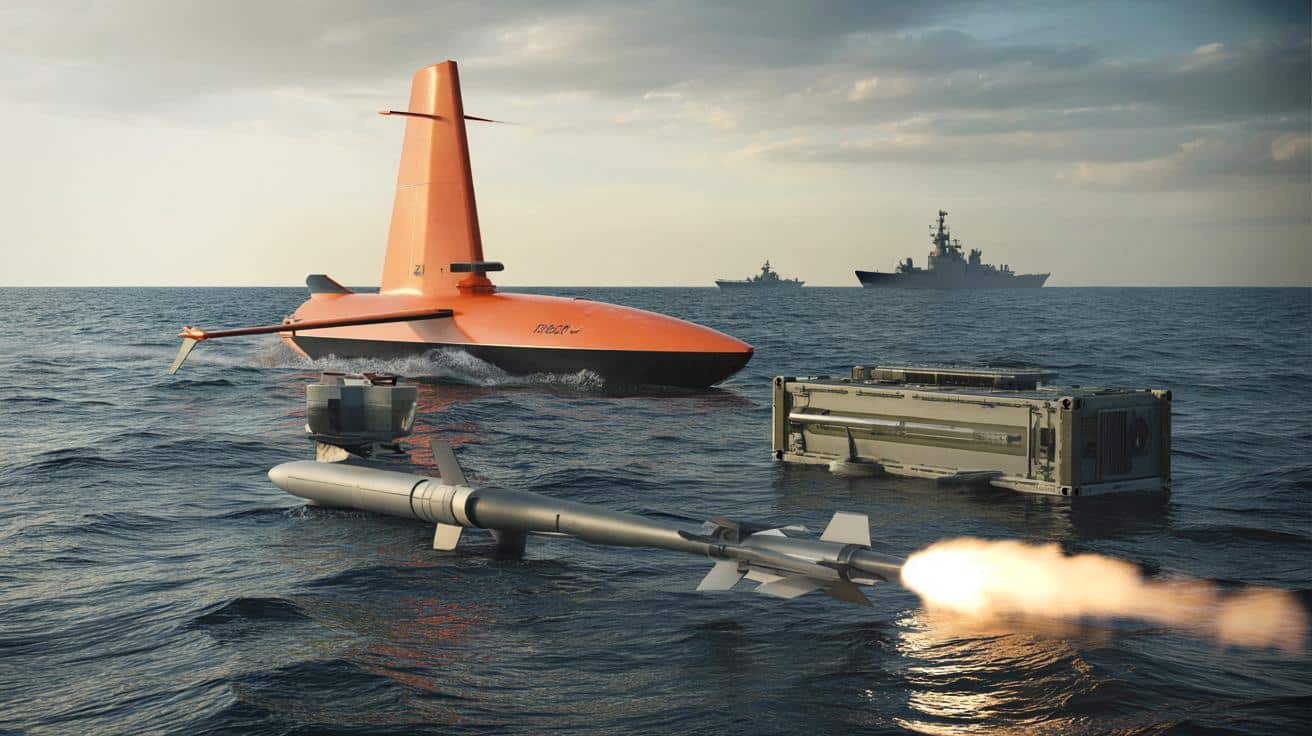
Saildrone is best known for its orange, wind‑ and solar‑powered surface drones that roam the oceans collecting climate and maritime data. Now, its 20‑metre Surveyor model is being reimagined as a strike‑capable naval asset.
The company will integrate Lockheed Martin’s Joint Air‑to‑Ground Missile (JAGM) onto the Surveyor, turning what began as an uncrewed mapping platform into a vessel able to identify and hit targets at sea or along coastlines.
The same unmanned boat that once charted the seabed could soon launch precision missiles at hostile ships.
JAGM is a precision weapon already fielded by US forces on helicopters and other aircraft. Fitting it to an unmanned surface vessel (USV) is a clear sign that navies are no longer treating drones as mere scouts, but as armed participants in a layered defence network.
Lockheed’s big bet on armed sea drones
Lockheed Martin is backing Saildrone with a reported $50 million investment, aimed at blending the drone firm’s autonomy and sensing experience with Lockheed’s missiles and battle‑management software.
Beyond JAGM, the partners are eyeing larger Saildrone hulls as potential hosts for the Mk 70 containerised Vertical Launching System. That system lets a standard shipping container act as a hidden missile battery, a concept that fits neatly with commercial‑looking uncrewed vessels.
- JAGM launchers on the 20 m Saildrone Surveyor
- Potential Mk 70 vertical launch cells on larger USVs
- AI‑driven detection and tracking of surface threats
- Networking with crewed ships and aircraft for targeting
The goal is to give navies a menu of armed unmanned options: small, relatively low‑cost boats that can be scattered across contested waters, feeding data back to fleets and, when authorised, firing missiles.
Humans still pull the trigger
The partnership leans heavily on artificial intelligence for sensing and data processing. Saildrone wants its boats to classify contacts, filter the noise of busy sea lanes and present only the most relevant threats to operators.
➡️ Aluminium foil in the freezer: a foolproof trick more and more people are using
➡️ The science is in: this is the most efficient and economical way to heat your home
➡️ The day I built a self-watering system from rubbish I never thought I’d keep
➡️ “I make it every Sunday in winter”: the potato–Brussels sprouts gratin that won over my whole family
➡️ Portugal to receive EU’s first drone carrier NRP D. João II in 2026 for Atlantic surveillance
➡️ UK and Australia deploy Typhoons and F-35 fighters to U.S. for Red Flag 26 combat training
Yet the company is drawing a clear line on autonomy. Saildrone president and retired US Vice Admiral John Mustin has stressed that the systems are not being developed as “fully autonomous weapons”.
Any missile launch from a Saildrone platform is planned with a human firmly in the decision loop, not left to algorithms.
That stance addresses one of the most contentious questions in defence technology: at what point does a smart weapon become an uncontrolled one? For now, the companies are framing the armed drones as extensions of human crews, not replacements.
Why navies want uncrewed firepower
Most major navies now sketch out their futures as “hybrid fleets” of crewed and uncrewed vessels. The US Navy, for instance, has floated a force structure of around 500 ships, including roughly 350 crewed vessels and 150 large unmanned platforms.
American lawmakers have already started backing that direction with money. A recent reconciliation bill, nicknamed the “One Big Beautiful Bill Act”, set aside over $3 billion for unmanned surface vessels, split between small and medium designs.
That said, Congress has demanded more clarity on how these boats will be used before releasing all the funds. A report from the US‑based Center for Maritime Strategy highlighted scepticism on Capitol Hill until the navy produces detailed concepts of operations.
From surveillance to strike missions
Until recently, naval drones mainly watched and listened. They tracked ships, mapped currents and carried out environmental monitoring. Politics, treaty concerns and technical limits kept weapons off most uncrewed hulls.
The war in Ukraine has changed that mindset. Ukrainian forces proved that relatively cheap unmanned surface craft, packed with explosives or guided from afar, can threaten and damage far larger and more expensive Russian warships.
Those Ukrainian attacks have become a case study in how small robotic craft can flip the cost equation of naval warfare.
Equipping Saildrone vessels with guided missiles builds on that lesson, but in a more conventional way: instead of suicide boats, the aim is re‑usable, networked launch platforms that stay at sea for months.
Different oceans, different challenges
Mustin has cautioned against assuming Ukraine’s approach will work everywhere. The Black Sea is geographically constrained, and Russian ships often operate closer to shore.
Other regions, such as the Pacific or Indian Ocean, involve vast distances, heavier seas and more complex air and missile threats. In those theatres, an armed USV will need longer legs, resilient communications and the ability to survive in far rougher conditions.
Saildrone platforms are already stress‑tested for endurance. Over the past year alone, the company says its vessels have logged more than 10,000 cumulative days at sea, sailing over 380,000 nautical miles and detecting more than 2.3 million ships.
| Metric | Saildrone performance (last year) |
|---|---|
| Cumulative days at sea | 10,000+ |
| Nautical miles covered | 380,000+ |
| Vessels detected | 2,376,583 |
That endurance – staying on station without resupply for months – is exactly what navies want when they talk about persistent surveillance and deterrence in remote waters.
Live‑fire trials on the horizon
Saildrone plans to move quickly from concept to demonstration. The firm has scheduled proof‑of‑concept integrations of the JAGM launcher and a live‑fire test for next summer.
Those trials will be watched closely by navies looking for ways to stretch their budgets. If a relatively inexpensive uncrewed craft can reliably launch and communicate with precision missiles in rough seas, it may change how smaller countries think about coastal defence too.
For industry, successful tests could open a fresh market: retrofitting existing uncrewed hulls, or even commercial‑style craft, with containerised launchers and standardised sensor packages.
What “layered maritime defence” really means
The phrase that keeps surfacing around this deal is “layered maritime defence”. Put simply, it refers to stacking different types of defences over distance and time so an enemy ship or missile faces multiple obstacles before reaching a target.
In a layered system, long‑range missiles, mid‑range drones, close‑in guns and electronic warfare all play a part. Armed USVs fit between high‑end warships and shore‑based batteries, filling gaps where crewed vessels would be too expensive or too vulnerable.
An armed Saildrone could shadow an adversary at distance, report its movements and, if ordered, contribute to a combined missile strike.
In a crisis in, say, the South China Sea or the Red Sea, a fleet might push USVs forward as pickets. They could relay radar and optical data back to destroyers over the horizon and act as decoys or additional shooters if tensions escalate.
Risks, ethics and where this could go next
Arming autonomous or semi‑autonomous systems always brings risk. Jamming, spoofed GPS signals or cyberattacks could disrupt communications. Designers need fail‑safes so that a hijacked or malfunctioning drone cannot launch weapons on its own.
Keeping a human in the loop for every strike order addresses part of this, but only if connections are secure and resilient. Long‑range operations in contested waters will pressure those links.
There is also a legal and ethical side. Navies must adapt rules of engagement for uncrewed platforms: who is accountable if a drone misidentifies a civilian vessel, or if a software bug leads to a misfire? Those questions are already being debated in arms control circles and will grow louder as more countries adopt armed drones at sea.
On the other hand, these systems could reduce risk to sailors by sending uncrewed craft into the most dangerous areas first. They can patrol mined waters, monitor choke points or shadow hostile ships without placing a human crew in immediate danger.
As Saildrone and Lockheed Martin push ahead with missile‑armed USVs, navies are being forced to think not only about new hardware, but also about new tactics, safeguards and diplomatic guardrails for a future where robotic boats might be the first units on the scene in any maritime crisis.