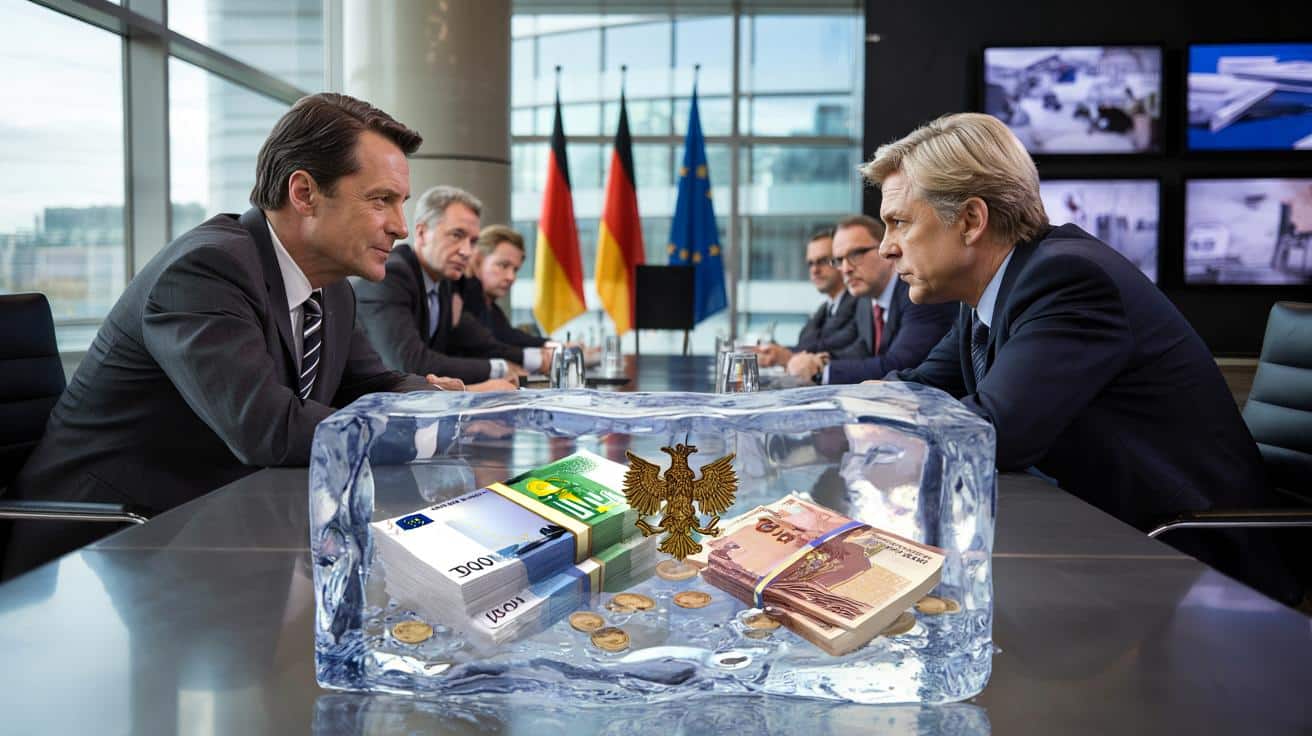
Germany is piling pressure on Belgium to back a controversial plan to use frozen Russian state assets for Ukraine’s war effort, turning a technical financial dispute into one of the European Union’s most politically charged arguments of the year.
Berlin pushes for tougher use of Russian funds
German Chancellor Friedrich Merz said on Friday that he is actively urging Belgium to strike a deal with the EU on tapping immobilised Russian central bank assets to support Kyiv. Speaking at a joint press conference with Slovenian Prime Minister Robert Golob, Merz framed the issue as part of a broader push to tighten the financial squeeze on Moscow.
Merz argued that using frozen Russian assets is “an appropriate instrument” to help end the war by increasing pressure on the Kremlin.
Germany has aligned itself with European Commission plans to channel proceeds from Russian central bank reserves into a large loan package for Ukraine. The proposal aims to raise around 140 billion euros (£119 billion) to cover looming gaps in Kyiv’s budget as the war drags into another year.
Yet turning that plan into reality requires the consent of member states, and Belgium’s hesitation is now at the centre of the debate.
Why Belgium is holding back
Belgium’s government is not challenging the idea of supporting Ukraine. Its concern is where the bulk of the frozen money physically sits: in Brussels-based securities giant Euroclear, a critical hub of the global financial system.
Out of roughly 235 billion euros in immobilised Russian central bank assets across the EU, about 210 billion euros are held by Euroclear alone. That concentration leaves Belgium feeling exposed if Moscow retaliates.
Brussels fears that moving from simply freezing Russian assets to actively using their proceeds could trigger severe legal challenges and potential countermeasures by Russia.
Belgian officials worry about several scenarios:
➡️ “At 63, I misunderstood my morning stiffness”: what my body needed instead
➡️ War in Ukraine: Crimea attacked as Russians lose MiG-29 fighter jet and advanced radar
➡️ A grave rewrites history: the first human gold jewellery was here
➡️ Portugal to receive EU’s first drone carrier NRP D. João II in 2026 for Atlantic surveillance
➡️ The science is in: this is the most efficient and economical way to heat your home
➡️ “I’m 65 and felt tired after short walks”: the breathing pattern that limited endurance
➡️ “I make it every Sunday in winter”: the potato–Brussels sprouts gratin that won over my whole family
➡️ These major cities are sinking: why their disappearance now looks inevitable
- Russian lawsuits in international courts targeting Euroclear and the Belgian state
- Retaliatory seizures of European assets still located in Russia
- Damage to Euroclear’s reputation as a neutral financial intermediary
- Long-term uncertainty for global investors who rely on the security of EU-based clearing houses
Euroclear has already been in Russia’s crosshairs. Moscow has made repeated threats directed at Western institutions holding Russian funds, warning of “consequences” if those assets are diverted to Ukraine.
Merz: legal fears should not block political resolve
Merz acknowledged he sees Belgian Prime Minister Bart De Wever’s concern as legitimate, but insisted that political responsibility must prevail over hesitation. He said he was in direct contact with De Wever about finding a compromise.
“We are looking for a joint solution with the Belgian state and also with Euroclear,” Merz said, calling for the “widest consensus possible” among EU countries.
The German chancellor dismissed Russian threats as largely performative, describing them as a “repeated ritual” that should not derail European decision-making. His message suggests Berlin is prepared to take on higher legal risk if that means Moscow shoulders more of the financial burden of its invasion.
For Germany, the frozen assets debate fits into a broader strategy: combine continued military aid to Kyiv with financial and economic pressure on Russia, rather than rely solely on sanctions that have already been in place for nearly two years.
The EU’s 140-billion-euro Ukraine plan
The European Commission’s blueprint centres on a relatively cautious legal approach. Instead of outright confiscating Russia’s principal deposits, the plan would use the interest and profits generated by those assets as collateral or income for a major loan to Ukraine.
| Item | Approximate value |
|---|---|
| Total Russian central bank assets frozen in EU | 235 billion euros |
| Assets held at Euroclear in Belgium | 210 billion euros |
| Planned EU loan package for Ukraine | 140 billion euros |
EU officials argue that using profits, not the underlying capital, stays closer to international law while still providing meaningful support for Ukraine. Yet even this narrower move risks being portrayed by Moscow as theft and could set a contested precedent in global finance.
Lawyers across Europe are divided. Some say Russian state actions in Ukraine justify exceptional measures. Others warn that if central bank reserves can be repurposed politically, future authoritarian regimes may hesitate to keep their funds in Western jurisdictions at all.
Belgium’s balancing act between solidarity and risk
Belgium faces a delicate calculation: show solidarity with Ukraine and EU partners while protecting a strategic national asset in Euroclear. The clearing house is not just another bank. It is part of the plumbing of global markets, settling transactions for governments, major banks and large investors worldwide.
If Euroclear were dragged into a wave of litigation or sanctions battles, confidence in EU-based market infrastructure could suffer. Belgian policymakers are anxious about unintended consequences, from higher operating costs to potential capital outflows to non-European financial centres.
For Belgium, the question is not whether to support Ukraine, but how to do it without turning a financial hub into a legal battleground.
Belgian diplomats are therefore pushing for cast-iron legal guarantees from the EU, shared liability among member states and clear limits on what can be done with Russian assets.
Growing pressure inside the EU
The dispute comes at a politically tense time. Kyiv’s finances are under strain as US aid becomes tangled in domestic disputes in Washington and fatigue grows among some European voters. EU leaders see the Russian assets as one of the last major untapped tools to keep Ukraine afloat without hitting their own taxpayers again.
Germany’s recent shift to a tougher line under Merz has raised expectations that other large EU states, such as France and Italy, will rally behind the Commission’s plan and isolate holdouts. Smaller states in central and eastern Europe, which feel most threatened by Russia, have already called for aggressive use of frozen funds.
Yet unanimity is still needed on key financial measures, meaning Belgium cannot simply be overruled. The search for a compromise is likely to revolve around how much risk the EU as a bloc is willing to underwrite on Belgium’s behalf.
Key concepts behind the fight over frozen assets
Two legal terms sit at the heart of the argument: “freezing” and “confiscation”. Freezing means a government blocks access to assets, but ownership remains unchanged. Confiscation means transferring ownership, usually to a state or designated fund.
The EU has so far limited itself largely to freezing Russian state and oligarch assets. Moving towards using the proceeds, or even the principal, pushes the line closer to confiscation. That is where questions about international law, property rights and state immunity start to intensify.
Another factor is the concept of sovereign immunity, which traditionally protects state assets from being seized in foreign courts. Some legal scholars argue Russia’s full-scale invasion of Ukraine erodes that protection, while others say immunity should not be redefined under political pressure.
Possible scenarios if the EU moves ahead
If the EU reaches an agreement with Belgium and activates the plan, several practical outcomes are likely:
- Ukraine gains a predictable multi-year funding source for its budget and reconstruction plans.
- Russia escalates its legal and diplomatic campaign, perhaps targeting European companies still active in its market.
- Other countries watch closely and reassess where they park their central bank reserves.
- Future conflicts could see calls to repeat the same tool, turning frozen reserves into a more routine instrument of pressure.
If Belgium continues to resist, the bloc will need fallback options. These could include a smaller, voluntary coalition of willing states using only the assets located in their jurisdictions, or a more modest scheme limited to taxing windfall profits earned by financial institutions on frozen Russian funds.
For investors and ordinary citizens, the debate may feel distant, but it intersects with broader questions: how far Western democracies are prepared to stretch legal and financial norms in response to war, and how much they are willing to risk the stability of the global financial system to constrain an aggressor.