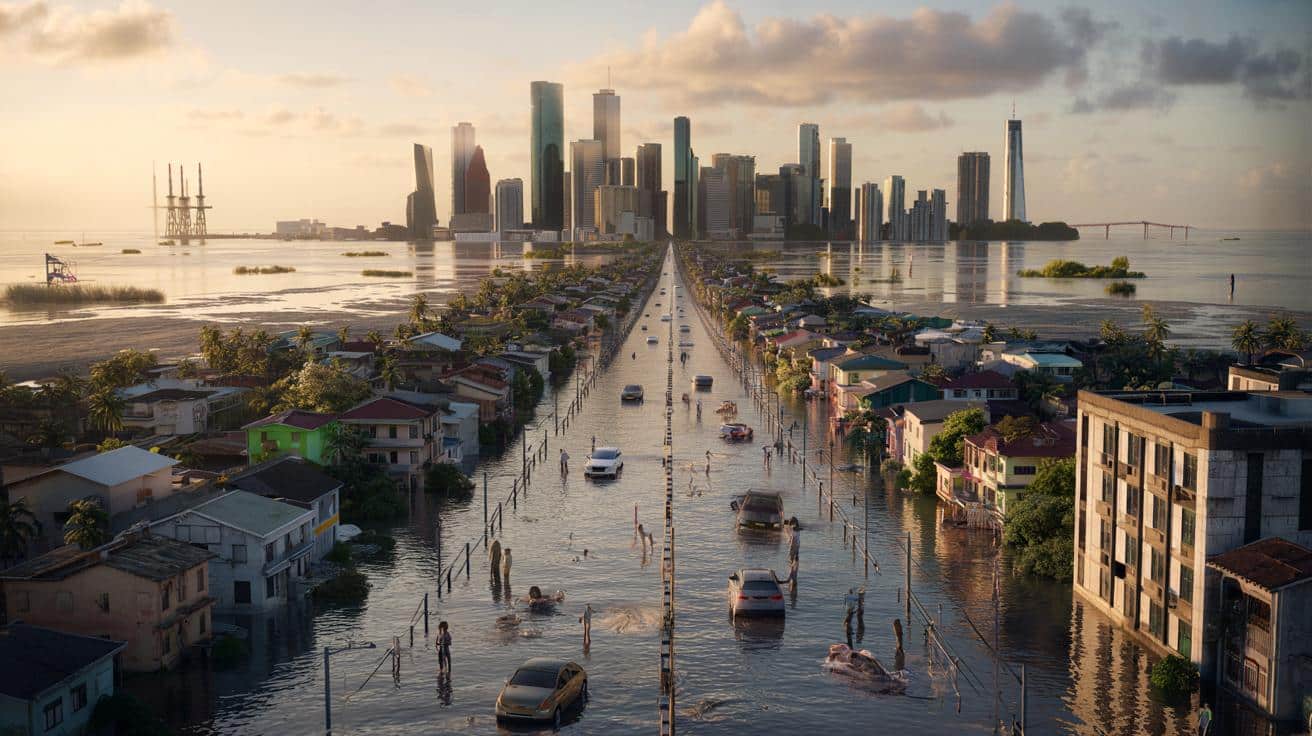
From Jakarta to Houston, from Lagos to Istanbul, parts of the urban landscape are slowly collapsing towards sea level. As the ground sinks and oceans rise, a long‑predicted clash between geology, engineering and climate change is starting to reshape the future of entire metropolitan regions.
What subsidence really means for coastal cities
Subsidence is the gradual sinking of land over time. In many cities, it is happening faster than local sea levels are rising. That means flood risk is driven not only by melting ice caps and expanding oceans, but also by the ground literally dropping away beneath roads, homes and skyscrapers.
A recent study published in the journal Nature Sustainability examined 48 major cities affected by subsidence. Together, they represent around one‑fifth of the world’s urban population. In several of them, parts of the city are sinking at more than 2 centimetres a year.
In the most affected districts, the ground can drop by the height of a smartphone every twelve months.
That sounds minor on a human timescale. Yet over 30 to 50 years, it can translate into half a metre or more of lost elevation. Combined with projected sea‑level rise and stronger coastal storms, that margin is often the difference between a functioning city and a flooded one.
The fastest sinking hotspots
Some cities now appear on a trajectory where large areas will become uninhabitable within decades unless drastic measures are taken.
- Jakarta, Indonesia – up to 26 mm of sinking per year, mainly due to groundwater extraction; the government is relocating the national capital more than 1,000 km away.
- Ahmedabad, India – as much as 23 mm per year, linked to rapid, unplanned urbanisation and intense pumping of aquifers.
- Istanbul, Turkey – up to 19 mm annually, with urban growth aggravating geological vulnerabilities along an already active seismic zone.
- Houston, Texas, United States – up to 17 mm per year, tied to oil and gas extraction and heavy groundwater withdrawals.
- Lagos, Nigeria – sinking by as much as 17 mm annually, fuelled in part by aggressive sand mining and coastal development.
- Manila, Philippines – up to 17 mm a year in some districts, where rapid growth sits atop soft, compressible ground.
Some coastal megacities are subsiding several times faster than global average sea‑level rise.
This imbalance is crucial. Global sea levels are currently climbing at roughly 3–4 mm per year. Where land sinks five times that speed, the relative height difference between land and ocean can shift by more than 1 metre in a single lifetime.
Mexico’s silent collapse
Mexico City, built on the sediments of an ancient lake, has become a symbol of irreversible subsidence. Parts of the metropolis have already fallen several metres over the past century as groundwater is pumped from deep clay layers, causing them to compact.
➡️ Help birds survive the coldest nights: this is the one food that brings their warmth back
➡️ U.S. Navy completes first Los Angeles-class fast attack submarine refueling overhaul
➡️ “At 63, I misunderstood my morning stiffness”: what my body needed instead
➡️ Germany pressing Belgium on frozen Russian assets
Engineers now say some of this deformation cannot be reversed. Old districts are criss‑crossed by cracked streets and tilted buildings, while water and sewage systems strain under warped foundations.
Once clay layers compress and collapse, the ground rarely rebounds. The city’s new “normal” is simply lower than before.
Why the ground is sinking beneath our feet
Subsidence has several overlapping causes, many of them linked to the way modern cities grow and consume resources.
Groundwater pumping and thirsty megacities
One of the main drivers is the extraction of groundwater from deep aquifers. When water is removed faster than it is naturally replenished, the pores in the underlying sediments close and the soil compacts. This effect is strongest in soft clays and unconsolidated sands.
Jakarta, Manila and Mexico City are clear examples. In districts where drinking water and industrial use rely heavily on wells, the land has slumped dramatically. As population and economic activity rise, the demand for water often outpaces investments in surface reservoirs or desalination plants, locking cities into a dangerous dependency on aquifers.
Heavy buildings on fragile soil
Dense urbanisation adds weight. High‑rise towers, dense apartment blocks, highways and industrial complexes all press down on the ground. On solid rock this is manageable, but on reclaimed land, former wetlands or soft sediment, the extra load can accelerate subsidence.
Coastal expansion projects – luxury marinas, business districts or artificial islands – are particularly prone to this. The new land is often built from dredged sand or fill, materials that can settle for decades, slowly lowering the surface level.
Sand mining, oil extraction and shifting deltas
In cities such as Lagos, removing sand from rivers and coastal zones for construction materials destabilises the shoreline and riverbeds. That can make nearby districts more prone to erosion and sinking.
Oil and gas extraction has a similar effect underground. Removing hydrocarbons from deep reservoirs can cause overlying layers to sag, as seen in parts of Houston and other energy hubs.
Across many river deltas, dams built upstream reduce the amount of new sediment reaching the coast. Without this constant replenishment, deltas compact and sink while the sea continues to encroach.
Europe and France: not spared, just slower
The situation in France and much of Europe is less dramatic in terms of speed, but the trend is similar. Several coastal and low‑lying cities sit on soft sediments and have long histories of groundwater use and land reclamation.
In Rotterdam, Venice or parts of western France, local authorities monitor subsidence and invest in dykes, pumping stations and building regulations to manage the risk. The rates are usually lower than in Southeast Asia or West Africa, yet when combined with rising seas and more intense storms, the margins of safety shrink.
Even “modest” sinking can turn a once‑in‑a‑century flood into a once‑in‑a‑decade event.
Which cities face the greatest long‑term threat?
Researchers often look at three factors together: how fast the land is sinking, how quickly the local sea level is rising, and how many people and assets sit in low‑lying zones.
| City | Max subsidence rate (mm/year) | Main drivers |
|---|---|---|
| Jakarta | ≈ 26 | Groundwater extraction, rapid urban growth, soft sediments |
| Ahmedabad | ≈ 23 | Unregulated urbanisation, groundwater pumping |
| Istanbul | ≈ 19 | Urban development, complex geology, seismic context |
| Houston | ≈ 17 | Oil and gas extraction, groundwater withdrawals |
| Lagos | ≈ 17 | Sand mining, coastal construction, delta processes |
| Manila | ≈ 17 | Groundwater use, dense urbanisation, soft ground |
Cities that tick all three boxes – fast sinking, rapid sea‑level rise, high population density – face the toughest choices. Many of their poorest residents live in flood‑prone districts with limited infrastructure, making adaptation costly and politically sensitive.
Can radical urban change prevent their disappearance?
Researchers increasingly frame the long‑term survival of these cities as a question of transformation rather than minor adjustments. Some strategies already being discussed or tested include:
- Strict limits on groundwater pumping, replacing wells with surface reservoirs, rainwater harvesting or desalination.
- Redesigning building codes to limit heavy construction in the most subsidence‑prone districts and favour lighter structures.
- Strategic retreat from the lowest‑lying areas, relocating neighbourhoods or key functions inland, as Indonesia plans for its capital.
- Restoring wetlands and mangroves to stabilise sediments and act as natural buffers against waves and storm surges.
- Constant monitoring using satellite radar and GPS to map where the ground is sinking fastest and adjust planning decisions.
Without deep changes to how cities use water, land and energy, many coastal districts may have to be abandoned within decades.
Key terms that shape the debate
Two notions frequently used by scientists and planners can help clarify what is at stake.
Relative sea‑level rise describes how quickly the sea is gaining height compared with the land at a specific location. If the ocean climbs 3 mm a year but the land sinks 10 mm, the relative change is 13 mm. That is what truly matters for local flood risk.
Managed retreat refers to the deliberate, planned movement of people, infrastructure and services away from high‑risk areas. Instead of waiting for a catastrophic flood or storm to wipe out a district, authorities gradually relocate residents and economic activities to safer ground.
What the next 50 years could look like
Researchers run computer simulations combining subsidence rates, sea‑level projections and urban growth. In many scenarios for 2070 or 2100, maps of Jakarta, Lagos or Manila show large swathes of current city blocks falling permanently below high tide levels, even with moderate climate warming.
In practice, that does not mean entire cities vanish overnight. It means more frequent tidal flooding, saltwater intrusion into drinking water supplies, longer outages for electricity and transport, and spiralling maintenance costs for defences. Insurance markets may pull back. Informal settlements may expand on marginal land, expanding human exposure to storms.
There are also knock‑on effects. As one coastal hub becomes less liveable, migration pressures rise on neighbouring regions. Trade routes, ports and industrial corridors may need to shift inland. The financial burden of protecting or relocating millions of people falls unevenly, often hitting countries that contributed least to global emissions.
For now, the sinking of these great cities proceeds quietly, a few millimetres at a time. The decisions taken in the coming decade – about water use, construction, and where to build or retreat – will determine whether future generations inherit fortified, adaptive coastal hubs or are forced to abandon large sections of today’s urban coastline.