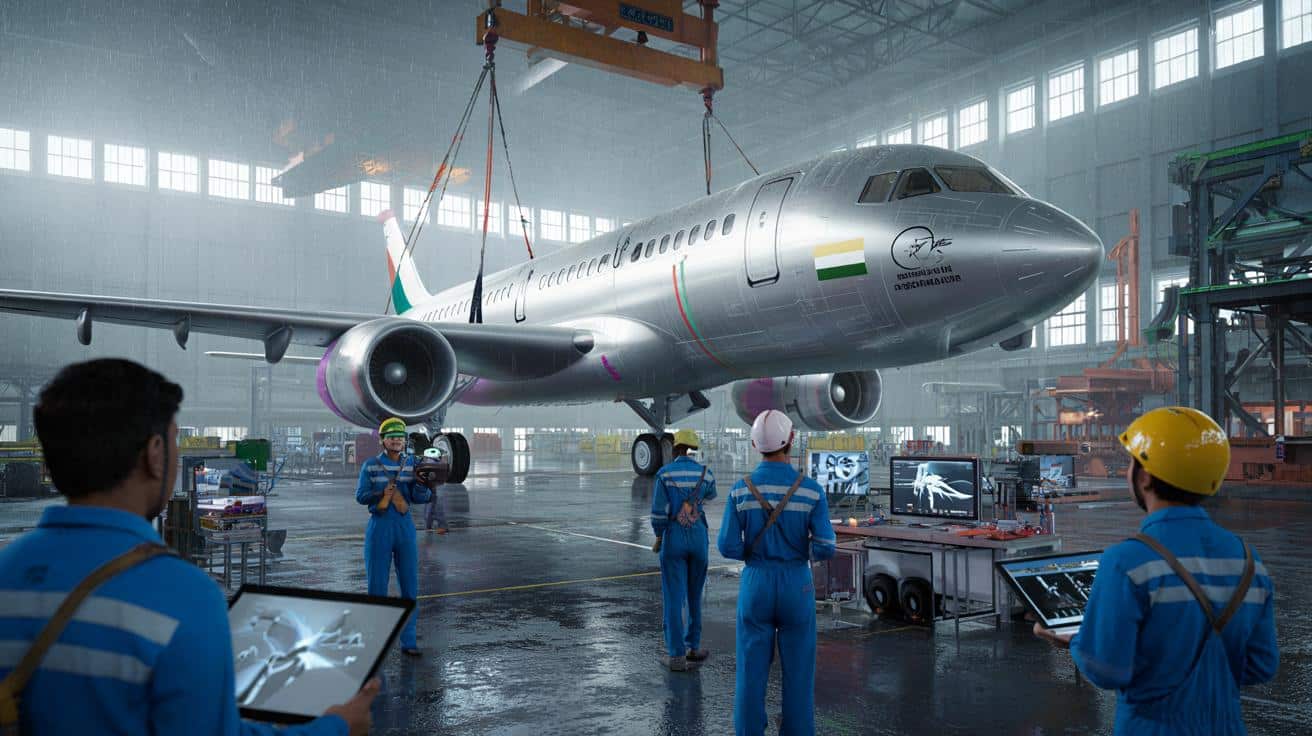
The monsoon rain was hitting the hangar roof in Hyderabad so hard it almost drowned the sound of the drills. On the floor, a handful of young engineers in blue overalls tilted their heads up as the bright white fuselage segment swung slowly from the crane, like a floating promise. Someone filmed on their phone, someone else shouted a nervous joke about “India’s first real answer to Airbus”. No one laughed for long. The stakes felt too big.
This wasn’t another software campus or a back‑office center. This was metal, composites, wings.
A new kind of Indian startup was taking shape, and this time it wanted to fly.
India’s unexpected leap from code to cabins
For years, when people said “Indian tech”, they meant code, not cockpits. Short-haul flights were full of Indian passengers, but the planes themselves carried badges from Toulouse, Seattle, or sometimes Beijing. Inside Indian airports, you could feel that strange mismatch: booming demand, jam-packed departure halls, yet the hardware belonged to someone else’s industrial dream.
Now, that quiet imbalance is starting to shift. Not with a state slogan, but with noisy factories, ambitious certification plans, and a new generation of engineers who want **their** logo painted on a jet’s nose.
The question hanging in the air: can India really pull off building a passenger jet brand… from scratch?
Think about the last time you boarded a flight in Delhi, Mumbai, or Bengaluru. The cabin crew probably spoke Hindi or a local language, the food tray had an Indian logo, the WhatsApp pings around you were all in familiar names. Yet the aircraft itself was almost certainly an Airbus A320 or a Boeing 737.
Behind that everyday scene lies a monster statistic. Domestic passenger traffic in India has more than doubled over the last decade, and the country is on track to become one of the world’s top three aviation markets. Airlines like IndiGo and Air India are stacking record orders worth tens of billions of dollars.
Until recently, all that money was outbound. Today, an emerging Indian aircraft maker wants a real slice of that pie.
The new player doesn’t look like the old aerospace giants. It borrows as much from the culture of software startups as from classic plane makers. Small cross-functional teams, prototypes rolled out in months instead of years, reliance on digital twins and AI testing before metal is even cut.
➡️ Portugal to receive EU’s first drone carrier NRP D. João II in 2026 for Atlantic surveillance
➡️ U.S. Navy completes first Los Angeles-class fast attack submarine refueling overhaul
➡️ “I make it every Sunday in winter”: the potato–Brussels sprouts gratin that won over my whole family
➡️ Ornithologists repeat it every year: this simple winter task can save baby birds
➡️ “At 63, I misunderstood my morning stiffness”: what my body needed instead
Behind the scenes, government labs, private conglomerates, and niche aviation specialists are quietly weaving a network. Some work on regional jets sized for India’s smaller cities, others on future electric-hybrid aircraft, others on avionics and cabins tailored to local airlines’ needs.
The logic is simple: if India can write the code that runs half the world’s servers, why can’t it design the jets that connect its own 1.4 billion people?
How an Indian jet actually gets from CAD file to runway
On the ground, building a passenger jet in India starts with something unglamorous: certification paperwork and patience. Engineers sit in glass-walled rooms in Bengaluru and Nagpur, staring at 3D models on multiple screens. They tweak wing angles by micrometers, test airflow simulations, and argue over weight trade-offs like chefs fighting over salt.
Then comes the physical grind. Composite panels baked in Indian autoclaves, titanium parts milled in industrial clusters that once made car components, wiring looms assembled by technicians who used to work on defense projects. Every rivet has to be logged, every bolt traced.
From the outside, it looks slow. Inside those hangars, the pace feels brutal.
One mid-level engineer I spoke to described the first full-scale fuselage test like a cricket final. Weeks of build-up, too little sleep, then suddenly every eye on one single frame under stress in a test rig near Bengaluru. They pumped pressure into the cabin to simulate high altitude. The metal groaned, the sensors spat numbers, a supervisor hovered over the emergency stop.
Nothing cracked. Just a high-pitched hiss and a room full of people who didn’t dare cheer too loudly, as if they might jinx it.
That test turned into a quiet milestone: the first time an all-Indian team had taken a passenger-sized fuselage through that kind of trial without foreign partners holding the steering wheel.
Once those early wins land, the game shifts from “can we build this?” to “can we build this at scale?”. That’s where the Indian advantage kicks in. The same ecosystem that scaled IT services and smartphones now eyes landing gear, seats, and avionics.
Domestic suppliers begin to retool. An auto-parts plant in Pune starts learning aerospace-grade quality. A defense contractor in Hyderabad tries its hand at civil certification. Universities adjust their courses, dropping in modules on aircraft structures and airline economics.
*The supply chain slowly stops being a PowerPoint slide and starts becoming a real, humming organism.*
What this means for travelers, and for the rest of the world
For passengers, the first obvious change will be subtle: the type of routes these Indian-built jets are designed to fly. Think short hops between second-tier cities, flights that today involve awkward connections through Delhi or Mumbai. Smaller, efficient regional jets with Indian DNA can unlock those links.
Design teams are already obsessing over cabin layouts for crowded, price-sensitive markets. Quicker turnarounds, smarter overhead bins, lavatories that can survive high-rotation flights without falling apart. It’s not glamorous, but it’s exactly where airlines feel the pain.
If an Indian jet can shave minutes off turnaround on a hot day in Jaipur, airlines will listen.
There’s also a psychological shift. For decades, “safe” in aviation often meant “Western-built” in the public mind. An Indian passenger stepping onto an Indian-designed jet for the first time will carry a tiny extra question in the back of their head. That’s normal.
We’ve all been there, that moment when you try a local brand for something you only ever trusted “big foreign names” with. That tension is real, and the new Indian makers know it. They’re stacking their project teams with veterans from Airbus, Embraer, and Boeing to calm regulators and reassure airlines.
Let’s be honest: nobody really reads the aircraft type on the boarding pass every single day.
Inside the industry, the real stakes are global. An Indian entrant doesn’t just mean more competition for Chinese manufacturers; it shakes the whole duopoly that has ruled the skies for decades. Airlines love having another option to play against Airbus and Boeing when negotiating prices and delivery slots.
One senior executive in Dubai summed it up bluntly:
“If India can deliver a certified, reliable 70–120 seat jet and keep it on time, the order books will follow. Airlines don’t have loyalty; they have spreadsheets.”
And that’s where the opportunity widens:
- Cheaper regional flights for smaller Indian cities, as operating costs drop.
- New manufacturing jobs in places that never saw an aircraft part before.
- Fresh pressure on legacy giants to innovate faster, and maybe treat customers a bit better.
An open question written in the sky
This Indian push into passenger jets sits at a strange crossroads. On one side, decades of catching up: missed chances, underfunded aviation projects, a long habit of just buying foreign. On the other, a young workforce that doesn’t see why jets should be any different from phones, rockets, or payments apps.
The timeline will be messy. There will be delays, test failures, political noise, and maybe one or two prototypes that never see commercial service. That’s how every aircraft story starts, from Seattle in the 1960s to Shanghai in the 2010s. The difference now is the mood on the factory floor in India: less deference, more stubborn confidence.
When the first Indian-designed passenger jet lines up on a runway with paying passengers on board, there won’t be fireworks in the cabin. People will be scrolling through reels, half-asleep, complaining about legroom. The moment might feel almost boring.
Yet somewhere, in a hangar far away, a group of engineers will be watching the live data feed with their hands shaking just a little. Because that first uneventful takeoff will say something quietly radical.
The world’s next serious maker of passenger jets might not come with a dragon on the tail, but with a tricolor flag and a story still being written.
| Key point | Detail | Value for the reader |
|---|---|---|
| India is moving from buyer to builder | Domestic teams are designing and testing regional passenger jets | Helps readers grasp why India keeps showing up in aviation headlines |
| New competition in the skies | An Indian maker joins Western and Chinese players in the jet market | Explains how this could change ticket prices and route options |
| Real-world impact on travel | Focus on short-haul, high-demand routes between smaller cities | Shows how future trips across India might become cheaper and easier |
FAQ:
- Will these Indian passenger jets be as safe as Airbus or Boeing?They have to meet the same global certification standards, with regulators checking every system and every test. Airlines won’t risk their reputation on aircraft that don’t clear those hurdles.
- When could I actually fly on an Indian-made jet?Timelines vary by project, but realistic commercial service is usually several years after the first prototype, once testing, certification, and airline trials are done.
- Are these jets only for Indian airlines?No. The target is India first, but the long game is exports to Asia, Africa, and maybe even Europe once certification lines up.
- Does this mean tickets will get cheaper?Not overnight, but more competition in aircraft supply can lower costs for airlines over time, which often leads to better fares and more routes.
- How is this different from China’s COMAC jets?China’s program is heavily state-driven and focused on larger single-aisle jets. India is starting with more modular, regional-focused projects and a mix of state, private, and startup energy.