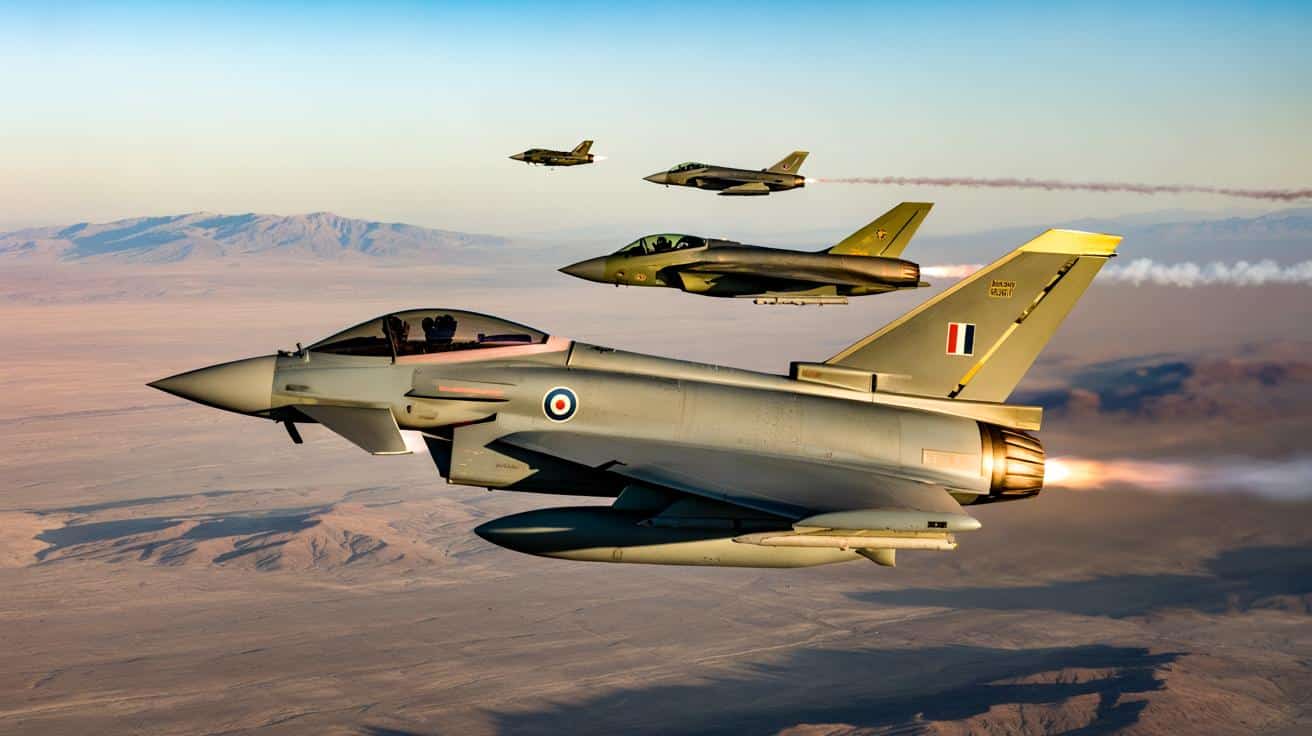
Far from any real frontline, British Typhoons and Australian F‑35s are joining U.S. forces at Nellis Air Force Base for Red Flag 26‑1, a high-end combat rehearsal designed to find the cracks in coalition airpower before any real enemy does.
Allied airpower converges on Nevada
This year’s Red Flag 26‑1 brings together a broad mix of aircraft, crews and command teams from the United States, United Kingdom and Australia. The exercise runs over the vast Nevada Test and Training Range, which offers more than 12,000 square miles of controlled airspace and 2.9 million acres of land dotted with mock enemy radars, missile sites and target complexes.
Organisers describe Red Flag 26‑1 as a “stress test” for coalition airpower, command-and-control and data sharing at the level needed for a peer fight.
Around 3,000 personnel and roughly 32 units are involved, spanning the U.S. Air Force and Space Force, U.S. Navy, Marine Corps and Air National Guard, alongside the Royal Air Force (RAF) and Royal Australian Air Force (RAAF). A dedicated tactical command team coordinates missions across air, land, maritime, cyber and space.
Australia brings F‑35 punch and Wedgetail control
Canberra has committed one of its largest recent overseas air deployments. Australia’s Department of Defence has confirmed the RAAF has sent:
- Up to six F‑35A Lightning II fighters
- One E‑7A Wedgetail airborne early warning and control aircraft
- Around 227 aviators and support personnel
The Australian contingent is taking part in both Red Flag Nellis and Bamboo Eagle 26‑1, a newer long‑range training series that stretches across the western United States.
Australian commanders frame the deployment as an “interoperability accelerator”, deliberately designed to feel as complex and uncomfortable as a real, large‑scale warfighting scenario.
F‑35A: stealth fighter as coalition core
The RAAF’s F‑35A Lightning II is a fifth‑generation multirole fighter that blends stealth with advanced sensors and high manoeuvrability. It can pull up to 9g, fly at around Mach 1.6 and operate at long range using only internal fuel.
Two subsystems define how it fights:
➡️ Germany pressing Belgium on frozen Russian assets
➡️ Saildrone, Lockheed to place missile launchers on naval drones
➡️ “At 63, I misunderstood my morning stiffness”: what my body needed instead
➡️ A grave rewrites history: the first human gold jewellery was here
➡️ These major cities are sinking: why their disappearance now looks inevitable
➡️ Ornithologists repeat it every year: this simple winter task can save baby birds
➡️ What is really the most efficient and energy‑saving space heater? Here’s the verdict
- Distributed Aperture System (DAS): a ring of infrared cameras that gives the pilot 360‑degree missile warning and day‑night vision.
- Electro‑Optical Targeting System (EOTS): a built‑in targeting pod for long‑range detection and precision strikes.
These sensors feed into a single fused picture in the cockpit, cutting pilot workload and enabling the F‑35 to act as a flying sensor node. Encrypted data links allow the jets to share that information with other fighters and command aircraft in real time.
In Australian thinking, the F‑35A is not a boutique stealth toy; it is the backbone of a future coalition strike and air defence package.
E‑7A Wedgetail: command ship in the sky
The E‑7A Wedgetail is the RAAF’s airborne battle manager. Its multi‑role electronically scanned array radar can watch airspace and maritime activity over more than four million square kilometres in a single mission. Mission crew at multiple consoles manage fighters, tankers and surface units while sharing data across secure links.
With in‑flight refuelling, Wedgetail can stay on station for extended periods, matching the tempo of long‑distance Bamboo Eagle missions and large Red Flag strike packages. The aircraft’s role is to turn a swarm of individual jets into a coordinated, mutually supporting force.
RAF Typhoons sharpen high‑end combat tactics
The UK’s main contribution is the Typhoon FGR4, supported by refuelling and intelligence assets. Once seen primarily as an air‑defence fighter, the Typhoon has evolved into a versatile, weapons‑rich multirole platform.
Powered by two EJ200 engines, the jet can reach speeds of around Mach 1.6 and climb to 55,000 feet. Its main sensors include the ECR‑90 radar and PIRATE infrared search‑and‑track, allowing it to detect and follow targets passively at long range.
The current RAF weapons fit underlines this multirole shift:
| Mission area | Key weapons on Typhoon FGR4 |
|---|---|
| Air superiority | Meteor, AMRAAM, ASRAAM |
| Precision strike | Paveway IV guided bombs |
| Anti‑armour / moving targets | Brimstone 2 |
| Long‑range stand‑off | Storm Shadow cruise missile |
| Close‑in engagements | 27mm Mauser cannon |
The Typhoon also carries a sophisticated defensive aids suite. Electronic support and countermeasures, missile‑approach warning sensors, expendable decoys and a towed radar decoy help the jet survive dense surface‑to‑air threats. That defensive layer is tested to the limit at Red Flag, where simulated enemy missile batteries line the routes to and from the targets.
For the RAF, Red Flag 26‑1 is a chance to fly Typhoons against a level of integrated air defence that is hard to replicate anywhere in Europe.
Signals, space and the fight for the spectrum
Beyond the headline fighters, intelligence and electronic warfare platforms add a subtler edge. The RAF’s RC‑135W Rivet Joint is present to detect and analyse signals across the electromagnetic spectrum. Its crews build real‑time intelligence on hostile radars, communications and emitters.
That role is gaining urgency as Red Flag scripts cyber and space challenges into its scenarios. Pilots may have to operate with disrupted GPS, degraded communications and bursts of hostile jamming, forcing them back onto pre‑briefed tactics and autonomous decision‑making.
Five Eyes cooperation gets a live test
Nellis Air Force Base runs three Red Flag iterations each year, including one tailored for the “Five Eyes” intelligence partners: the U.S., UK, Australia, Canada and New Zealand. Red Flag 26‑1 is part of that framework, which allows participating nations to share sensitive tactics, techniques and mission data that would not be released more widely.
This is not just about flying together; it is about integrating at the level of classified procedures and shared digital battle plans.
Because many of the systems involved operate on encrypted networks and rely on classified software, getting them to talk cleanly to each other is a major technical task. Doing that in a realistic setting, with the pressure of time and enemy threats, tends to expose weak spots that would remain hidden in smaller local exercises.
Why the first ten “virtual” missions matter
Red Flag was born from a painful lesson. During the Vietnam War, U.S. data showed pilots were most likely to be shot down during their first ten combat missions. The idea behind Red Flag was to make those ten missions happen in training instead, under safe but harsh conditions.
Today’s scenarios go far beyond simple air‑to‑air combat. Large strike packages must dodge sophisticated surface‑to‑air missiles, while dealing with electronic jamming, decoy targets, cyber disruption and the risk of space‑based surveillance. Losses are simulated, but the consequences are treated seriously: if a key tanker or command aircraft is “killed”, the mission must adapt or fail.
Bamboo Eagle and Indo‑Pacific distance problems
The parallel Bamboo Eagle exercise, introduced in 2024, pushes many of the same participants into longer‑range and more expeditionary missions across the western United States. For Australia, that training mirrors the distances that dominate Indo‑Pacific planning, where bases and refuelling chains could be spread over thousands of miles.
Large multinational missions are built so that no single aircraft type can achieve the objective alone. Fighters depend on tankers, tankers depend on air cover, and all of them rely on the command and surveillance picture from platforms like Wedgetail and Rivet Joint.
Key terms and real‑world scenarios
Several concepts running through Red Flag 26‑1 can sound abstract but map directly to potential future crises:
- Peer conflict: military planners use this term when thinking about a clash with a state of comparable strength, rather than a smaller or less advanced opponent.
- Multi‑domain operations: combining air, land, sea, cyber and space effects into a single, coordinated campaign.
- Interoperability: the ability of different forces to share data, fuel, weapons and command structures efficiently during combat.
A typical scenario might see Typhoons tasked to defend high‑value assets, while F‑35s sneak forward to locate and quietly mark enemy missile batteries. Wedgetail crews orchestrate the picture, routing strike jets through gaps in radar coverage, while Rivet Joint teams monitor enemy emitters and cue electronic attacks. One mis‑timed manoeuvre, or a broken data link, can unravel the whole plan.
Exercises like Red Flag and Bamboo Eagle carry their own risks: high jet usage, complex flying and the chance of training accidents. The benefits, though, are tangible. Crews leave having already “flown” those dangerous first combat missions, command staffs have rehearsed crisis decision‑making, and engineers have seen how their systems behave when pushed to the edge of their envelopes alongside allied hardware.