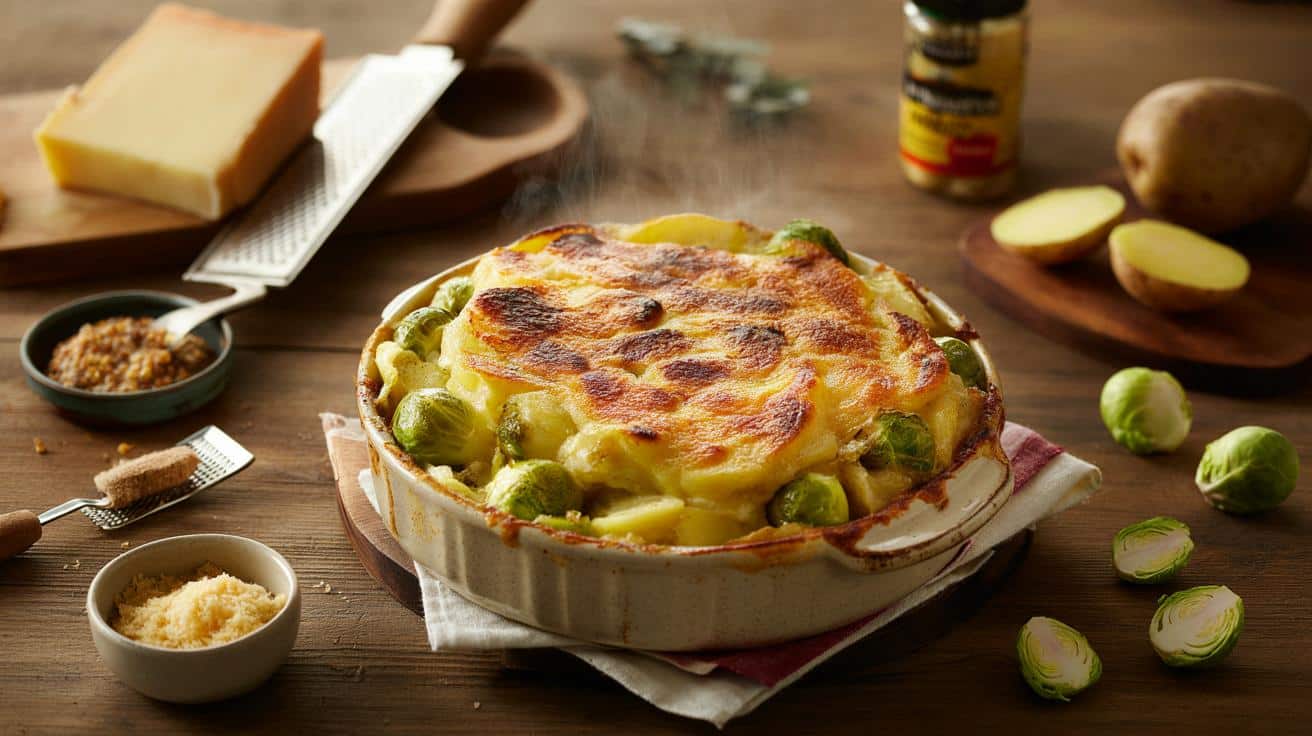
Inside, a single baking dish quietly takes charge of Sunday evenings.
When temperatures drop and daylight vanishes by mid-afternoon, families start reaching for recipes that feel like a blanket. One simple gratin, built from potatoes, Brussels sprouts and a punchy creamy sauce, has become the star of a French household’s winter routine – and it’s easy to see why.
The quiet rise of the “unfashionable” vegetable
For years, Brussels sprouts have had a terrible reputation. Many people remember them as grey, overcooked and bitter. Yet across Europe, home cooks are quietly rehabilitating this small cabbage by roasting, frying and, increasingly, baking it in rich gratins.
In this particular family, the turning point came with a dish that appears on the table almost every Sunday once the cold sets in: a layered potato and Brussels sprouts gratin, drenched in mustard cream and buried under a blanket of cheese.
This is not a side dish that sits politely at the edge of the plate. It takes centre stage and dictates the rest of the meal.
The recipe is French in spirit but easy to adapt anywhere. The idea is simple: balance the slight sharpness of Brussels sprouts with the softness of potatoes, then bind everything in a sauce that’s both comforting and bright.
What goes into the gratin?
The success of this dish rests on a short list of ingredients, all easy to find in winter. Quality matters, especially for the dairy and cheese.
- Waxy potatoes that hold their shape (Charlotte, Amandine or Yukon Gold)
- Fresh, firm Brussels sprouts
- Thick double cream (or heavy cream with at least 30% fat)
- Two mustards: a grainy “old-style” one and a strong Dijon
- A flavourful melting cheese like Comté or Swiss Gruyère
- Butter, a clove of garlic, salt, black pepper and a little nutmeg
Nothing revolutionary on paper. The magic lies in how these ingredients are treated: brief pre-cooking to tame the sprouts, paper-thin slicing to help the potatoes melt, and a generous hand with seasoning.
A Sunday ritual, step by step
Preparing the vegetables so they behave in the oven
Brussels sprouts need a bit of care. The outer leaves are trimmed away, the base is cut, and the sprouts are briefly blanched in salted boiling water for around five minutes. This quick pre-cook softens them and reduces bitterness. An icy rinse afterwards fixes their bright green colour before they’re halved lengthways.
Potatoes, peeled and washed, are sliced into thin rounds, roughly 3 mm thick. A mandoline makes the job fast and uniform, but a sharp knife works as well. Thin slices cook evenly and give that tender, almost melting texture once baked.
➡️ What is really the most efficient and energy‑saving space heater? Here’s the verdict
➡️ Saildrone, Lockheed to place missile launchers on naval drones
➡️ U.S. Navy completes first Los Angeles-class fast attack submarine refueling overhaul
➡️ A grave rewrites history: the first human gold jewellery was here
➡️ Ornithologists repeat it every year: this simple winter task can save baby birds
➡️ The science is in: this is the most efficient and economical way to heat your home
➡️ Aluminium foil in the freezer: a foolproof trick more and more people are using
The contrast is deliberate: soft, creamy potatoes against Brussels sprouts that still hold a slight bite.
The mustard cream that ties it all together
In a bowl, thick cream is whisked with a spoonful of strong Dijon and a larger spoonful of grainy mustard. The combination adds heat, texture and depth, without overwhelming the vegetables.
Salt, plenty of freshly ground black pepper and a light grating of nutmeg go in next. Nutmeg is a classic partner of creamy, cheesy bakes and gives the dish a subtle warmth that lingers.
Layering the gratin like a lasagne
The baking dish gets a simple but effective treatment: rubbed with a cut clove of garlic for a hint of flavour, then generously buttered. From there, the layers start to build.
- First, a layer of potato slices, slightly overlapping.
- Then, a scattering of halved Brussels sprouts.
- A ladle of mustard cream, spread to reach every corner.
- A small handful of grated cheese, without covering everything yet.
These steps repeat until the dish is nearly full. The remaining cream is poured over the top so it seeps down between the layers. The rest of the cheese is then scattered across the surface, forming the promise of a golden crust.
The gratin bakes at around 200°C (about 390°F) for roughly 25 minutes, sometimes a bit more depending on the oven and the depth of the dish. The goal: tender vegetables and a deep, burnished top.
From side dish to full winter feast
Once out of the oven, the gratin needs a few minutes to settle. The cream thickens as it cools slightly, which makes serving much easier and stops the sauce from flooding the plate.
On some Sundays, this gratin is the meal on its own. On others, it becomes the foundation for a bigger feast.
Classic pairings for a hearty plate
In eastern France, cooks often serve such a dish with smoked sausages like Morteau or Montbéliard. Their deep, smoky flavour works well with the tang of mustard and the sweetness of cooked cabbage.
For a British or American table, similar roles can be played by:
- Smoked pork sausages or kielbasa
- Grilled pork chops or a slow-roasted shoulder
- Leftover roast chicken or turkey, warmed in the oven
Those who prefer a lighter meal often set the gratin next to a big salad. Bitter leaves such as frisée or rocket, dressed with a sharp cider or white wine vinaigrette, cut through the richness and keep the plate balanced.
Why this gratin works, even for sprout sceptics
The key question with any Brussels sprout dish is: will the haters accept it? In this case, the answer tends to be yes, and not only among children.
| Element | Role in the dish |
|---|---|
| Blanching the sprouts | Softens texture and reduces bitterness |
| Thin potato slices | Create a soft, cohesive base that people recognise and trust |
| Mustard cream | Adds tang and warmth, masking any lingering sharpness |
| Cheese crust | Gives a savoury, toasty top that signals comfort food |
Psychology plays a part too. Served alone on a plate, sprouts can feel like a duty. Tucked into a browned, bubbling gratin, they become part of a bigger story: a shared dish placed at the centre of the table, from which everyone helps themselves.
Practical tweaks for busy winter kitchens
For weeknights or hectic Sundays with guests, the recipe can be adjusted without losing its character.
- Prepare the vegetables and cream mixture in the morning and keep them in the fridge, then assemble and bake in the evening.
- Par-bake the gratin for 15 minutes earlier in the day, cool it, then finish baking just before serving.
- Swap part of the cream for milk or stock if you want a slightly lighter result.
- Add a handful of lardons, bacon pieces or leftover ham between the layers for a one-dish meal.
Leftovers keep well in the fridge for two to three days. Reheating in the oven or an air fryer restores the crust better than a microwave, which tends to soften everything.
Nutrition, comfort and a different way of seeing winter food
Brussels sprouts bring more than texture and flavour. They are rich in vitamin C, vitamin K and fibre. Potatoes supply complex carbohydrates and potassium. The cream and cheese add fat and protein, which make the dish filling, though also quite energy-dense.
For those watching their intake, portion size and accompaniments matter. Serving a moderate square of gratin with a large bowl of salad or steamed greens can create a meal that still feels indulgent without being too heavy.
Seen this way, the gratin becomes less of a guilty pleasure and more of a clever compromise between comfort and nourishment.
There is also a cultural dimension. Ritual dishes like this one structure the winter season. They tell children that Sunday has its own flavour and rhythm. They turn a potently divisive vegetable into a shared favourite. And they show that with thoughtful seasoning and technique, the most modest ingredients can win over an entire family, week after cold week.