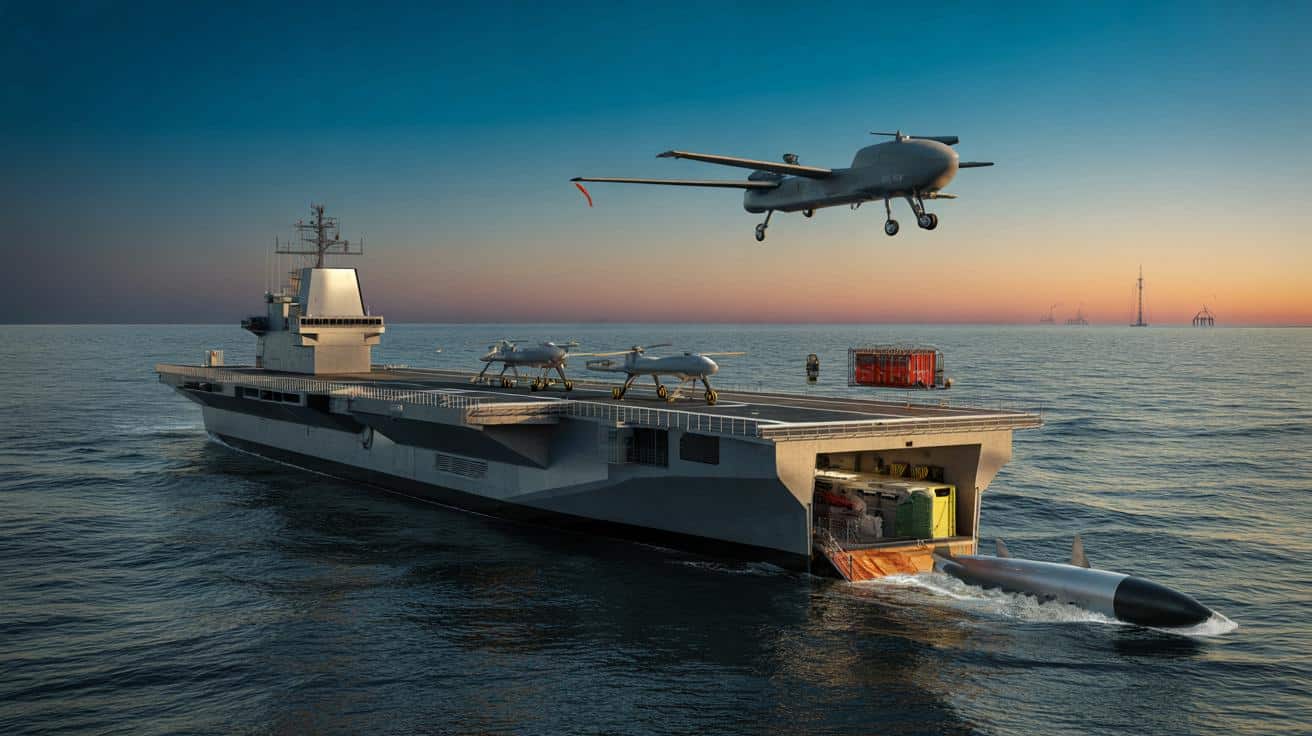
Portugal is preparing to launch a vessel that quietly rewrites how Europe thinks about maritime power, data gathering, and coastal security — and it is doing so with a ship designed from day one around unmanned systems.
Portugal’s bold step into drone-led naval power
The Portuguese Navy is set to receive the NRP D. João II in late 2026, a 7,000-ton ship billed as the European Union’s first purpose-built drone carrier. It is under construction at Damen’s Galati shipyard in Romania, following a contract signed in Lisbon in November 2023.
Portugal will be the first EU member state to deploy a warship whose primary mission is to operate unmanned aerial, surface and underwater vehicles.
While other countries have converted existing ships to handle drones, Portugal has opted for a clean-sheet design known formally as the Multifunctional Naval Platform. The focus is clear: long-duration missions over a vast maritime area, with fewer sailors and more robots.
The ship takes its name from King João II, the 15th-century monarch who backed Atlantic voyages that expanded Portugal’s reach. Lisbon now hopes this modern D. João II will extend the country’s influence again, this time through data, surveillance and technology rather than caravels and caravels.
Why a drone carrier, and why now?
Portugal’s strategic problem is simple to describe and hard to manage: a huge sea to watch, and limited resources to watch it. The country oversees roughly 4 million square kilometres of maritime space, including one of Europe’s largest Exclusive Economic Zones.
Traditional frigates and patrol vessels can cover this area, but they are expensive to run and need large crews. At the same time, unmanned systems have moved far beyond experimental status and now provide long-range surveillance, communications relay, seabed mapping and, in other navies, strike capabilities.
The NRP D. João II is designed to keep a constant eye on the Atlantic while cutting crew burden and boosting the reach of the Portuguese fleet.
Naval planners also point to growing tension in the Atlantic. Between 2022 and 2024, Portuguese authorities tracked 143 Russian vessels near the country’s coast, including submarines and specialist ships linked to undersea cable surveillance. At least eight Russian units were detected in waters under Portuguese jurisdiction in 2025 alone.
➡️ Ornithologists repeat it every year: this simple winter task can save baby birds
➡️ The science is in: this is the most efficient and economical way to heat your home
➡️ A new maker of passenger jets arrives: it’s not Chinese but Indian
➡️ “At 63, I misunderstood my morning stiffness”: what my body needed instead
This has raised concerns about sabotage or intelligence-gathering operations targeting seabed infrastructure. A dedicated drone carrier gives Portugal a way to stay present, to verify what is happening below the surface, and to share data quickly with allies.
How the ship will be built and paid for
The Multifunctional Naval Platform programme had a bumpy start. A first tender launched in June 2022 drew no bids and had to be reworked with more money and a longer schedule. Construction finally began with the first steel cut in October 2024 at Damen’s Galati yard.
The budget for the NRP D. João II stands at €132 million. Funding comes from two main sources:
- €94.5 million from the EU Recovery and Resilience Plan
- €37.5 million from the Portuguese state budget
For context, Portuguese officials regularly contrast this with the multi‑billion‑dollar price tag of classic aircraft carriers operated by the US and UK. While not directly comparable in role or scale, the comparison highlights the drive for a more affordable, unmanned‑centric approach.
A modular mothership built around drones
The NRP D. João II has been conceived as a flexible platform rather than a single‑mission asset. Its systems can be reconfigured in about a week, allowing the Navy to switch between scientific, civil protection and security roles without rebuilding the ship each time.
| Key characteristic | NRP D. João II |
|---|---|
| Length | 107.6 m |
| Beam (width) | 20 m |
| Displacement | ~7,000 tonnes |
| Maximum speed | About 15.5 knots |
| Endurance | Up to 45 days |
| Core crew | 48 personnel |
| Additional specialists | Up to 42 |
The ship’s layout revolves around unmanned systems:
- A 94‑metre continuous flight deck for launching and recovering aerial drones
- Hangars for drone assembly, storage and maintenance
- Facilities for medium helicopters such as NH90 or SH-60, and space for heavy helicopters like the EH‑101
- Dedicated hangars, launch and recovery gear, and a stern ramp for unmanned surface and underwater vehicles
Below deck, modular payload zones can hold up to 18 standard 20‑foot containers. These can be fitted out as laboratories, hospital units, hyperbaric chambers for divers, or specialised mission modules. There is also room for 18 light vehicles, including ambulances, and up to ten boats in addition to the ship’s organic craft.
The ship is designed as a kind of maritime “plug-and-play” platform, where mission equipment can be swapped quickly as needs change.
High-tech architecture and data-driven missions
The NRP D. João II is being built as a digital ship as much as a physical one. Its architecture includes high-performance computing, large data storage, and integration of artificial intelligence tools for processing information from multiple sensors and drones.
The Navy plans to use digital twin technology — a detailed virtual model of the ship and its systems — to support maintenance, planning and training. The open-systems approach means new sensors, autonomy software or communication systems can be integrated later without fundamentally redesigning the vessel.
Schottel has been selected to provide two EcoPeller SRE 560 azimuth thrusters and a transverse thruster, boosting manoeuvrability in confined waters or during complex launch and recovery operations for unmanned craft. Two Tier III-compliant engines power the ship while meeting stricter emissions standards.
Onboard laboratories and communications networks will support real-time data sharing with universities, research centres and government agencies. The vessel will also serve as a test bed for Portugal’s wider innovation ecosystem, including the Infante D. Henrique technology test area in Tróia.
From ocean science to crisis response
Scientific and environmental roles
Beyond defence, the Portuguese government is framing the D. João II as a tool for better understanding and protecting the Atlantic. Mission sets include:
- Oceanographic research and mapping of deep-sea ecosystems
- Environmental and meteorological monitoring over long periods
- Real-time tracking of pollution, algal blooms or oil spills
- Seabed inspection using the ROV Luso, which can operate down to 6,000 metres
By combining drones, crewed sensors and onboard analysis, the ship can act as a roaming research hub. Its endurance of up to 45 days at sea makes it suitable for remote Atlantic missions far from shore support.
Civil protection and humanitarian missions
The NRP D. João II is also being prepared for emergencies. In crises, the ship can temporarily host 100 to 200 additional people, functioning as an evacuation and shelter platform.
Possible roles include:
- Search and rescue operations after storms or shipwrecks
- Medical support and casualty evacuation
- Assistance to coastal communities hit by natural disasters
- Extraction of civilians from high-risk or conflict zones
Drones could be used to locate survivors, assess damage or deliver supplies to areas where landing is difficult or dangerous.
Guarding cables, seabeds and shipping lanes
From a defence standpoint, the new ship is deeply tied to concerns about hybrid threats at sea. Undersea cables that carry internet and financial data, offshore energy platforms, and key shipping routes all lie within or near Portugal’s maritime zones.
Unmanned surface and underwater vehicles launched from the D. João II will be used to inspect seabed infrastructure and detect suspicious activity around it.
Aerial drones can patrol wide areas, extend radar and camera coverage, and act as communication relays. Underwater drones and remotely operated vehicles can check for tampering with cables, conduct mine countermeasure tasks, or build detailed maps of the seabed in sensitive areas.
Given the increased presence of non-NATO naval units in the Atlantic, Lisbon sees this combination of sensors as a way to spot anomalies early and share warning data with allies before incidents escalate.
How unmanned fleets are controlled at sea
Operating large numbers of drones from a single ship brings its own challenges, especially around cybersecurity and command and control. The NRP D. João II will rely on encrypted links, redundant communications paths and network segmentation to reduce the impact of jamming or hacking attempts.
Conceptually, the ship acts as a floating operations centre. Human operators supervise multiple autonomous platforms, set mission parameters, and step in when systems reach certain decision thresholds. Portuguese officials stress that human oversight remains central, particularly for any mission with security or potential kinetic effects.
This approach mirrors trends in other navies experimenting with “manned–unmanned teaming”, where crewed ships direct remote assets to take on the dull, dangerous or data-heavy tasks.
What a drone carrier actually changes at sea
For readers outside the defence world, a “drone carrier” may sound like a small aircraft carrier, but the operational impact is different. Rather than projecting fast jets, the NRP D. João II projects sensors.
In a practical scenario, the ship could loiter near an undersea cable junction, launch a mix of aerial drones and underwater vehicles, and create a layered picture of everything moving in that area. It could then combine that feed with satellite data and information from other NATO ships, flagging patterns that might point to covert activity.
On another day, the same hull could be reconfigured with extra labs and medical modules, supporting a scientific cruise or humanitarian operation. That modularity is what differentiates this ship from classic high-value warships tied to a single role.
Key terms and future questions
The project also brings some useful defence terms into public debate:
- Unmanned aerial vehicles (UAVs): Aircraft without pilots on board, controlled remotely or flying autonomously.
- Unmanned surface vehicles (USVs): Boat-like platforms that operate on the sea surface, often used for patrol, minehunting or communications.
- Unmanned underwater vehicles (UUVs): Submersible robots that can inspect cables, map the seabed or search for objects at depth.
- Digital twin: A detailed virtual replica of a physical system used to simulate performance, maintenance and upgrades.
The NRP D. João II also raises future questions. Other European navies are already showing interest in the concept, especially since Portugal chose not to patent it. That could lead to similar platforms across the EU, potentially forming a network of drone-centric ships monitoring different maritime regions.
At the same time, there are risks: dependence on software, cyber vulnerabilities, and the need to train sailors for a data-centric, high-tech environment rather than classic seamanship alone. How Portugal manages that transition on this first-of-its-kind European drone carrier will shape whether the experiment becomes a new standard or stays a national one-off.