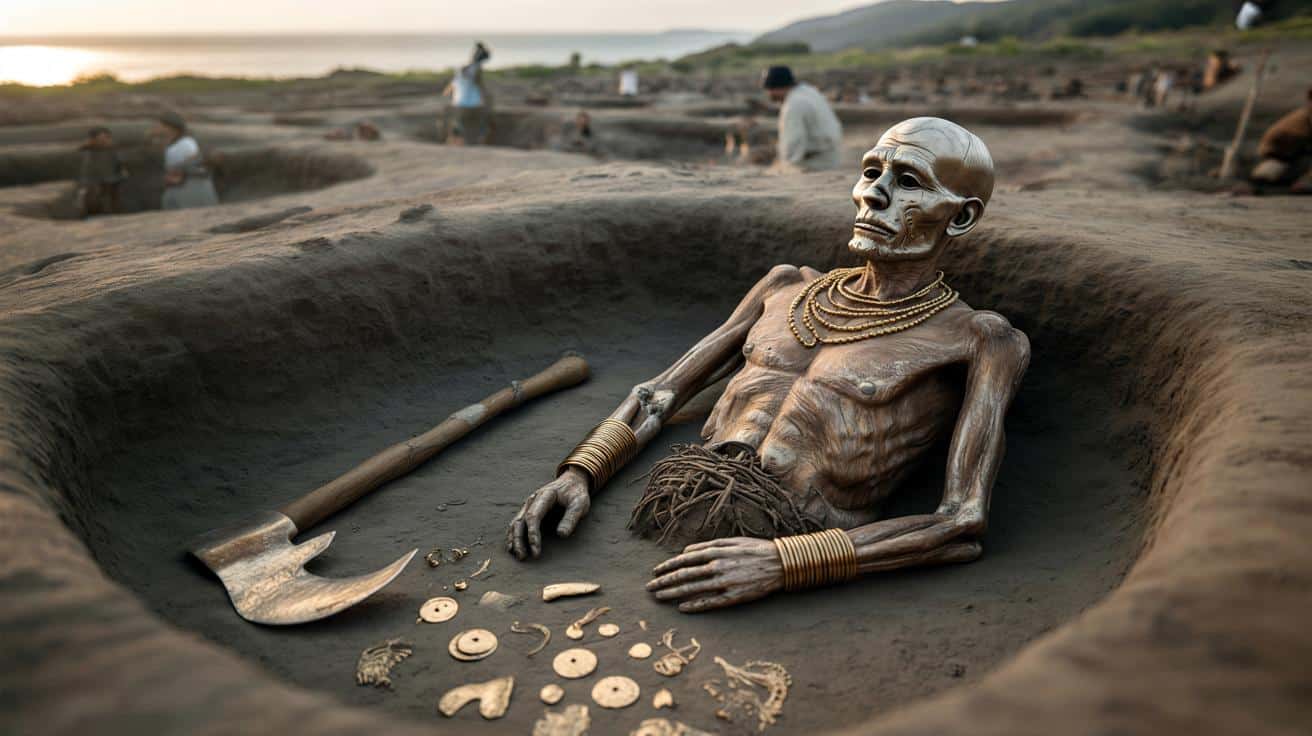
Hidden beneath an industrial site near Varna, in eastern Bulgaria, archaeologists uncovered hundreds of graves packed with treasures. What they found did not just push back the date of the first gold jewellery. It forced researchers to rethink when power, status and social inequality truly began.
The Black Sea cemetery that should not exist
In the autumn of 1972, construction workers outside Varna hit something hard with their shovels. It was not a pipe or rock, but a human grave. Local authorities called in archaeologists. Their initial trench opened onto a vast prehistoric necropolis, dating from around 4600 to 4300 BCE.
Across roughly 20 years of excavations, researchers uncovered around 300 graves. Sixty‑two of them contained objects made of gold. Necklaces, bracelets, earrings, bead pendants and tiny discs that once sparkled on clothing appeared by the handful. In total, more than 3,000 artefacts came out of the soil.
All together, the gold from the Varna necropolis weighs over six kilograms, making it the oldest known worked gold on Earth.
That pushes deliberate goldsmithing back some 6,600 years. A single gold bead found at another Bulgarian site in 2016 might be slightly older, but its dating remains debated. Varna’s cemetery, by contrast, rests on firm chronological ground. Radiocarbon analysis of human bones and organic remains fixes the community in the late Stone Age, during what archaeologists call the Copper Age, or Chalcolithic.
This was a moment when humans across Eurasia were still using stone tools, but had begun experimenting with metals. Copper was hammered into axes, awls and ornaments. Gold, too soft for weapons or tools, became something else entirely: a visible marker that a person mattered more than their neighbours.
Grave 43: an old man buried like a ruler
Among all the burials at Varna, one stands out. Archaeologists refer to it simply as Grave 43, but its occupant has gained a near‑legendary status in prehistoric studies.
The grave contained the skeleton of a man who died at more than 60 years of age – already notable for such an early period. Around and on his body lay a staggering concentration of wealth. Nearly a third of all the gold recovered from the cemetery came from his tomb alone.
Gold beads framed his head and chest. Bracelets adorned his arms. A ceremonial axe with a gold‑covered handle rested near him. Scattered around were more ornaments and symbolic objects, many never meant for practical use.
➡️ “At 63, I misunderstood my morning stiffness”: what my body needed instead
➡️ “I’m 65 and felt tired after short walks”: the breathing pattern that limited endurance
➡️ UK and Australia deploy Typhoons and F-35 fighters to U.S. for Red Flag 26 combat training
➡️ The science is in: this is the most efficient and economical way to heat your home
➡️ What is really the most efficient and energy‑saving space heater? Here’s the verdict
One item above all has fascinated researchers: a gold sheath interpreted as a penile cover, a unique expression of male prestige.
This object, unlike any known from the same era, signals more than vanity. It suggests that sexual and reproductive power were consciously displayed and linked to social rank. Together with the rest of the grave goods, it paints a portrait of a man occupying a position far beyond that of a village elder.
Curators at the Varna Archaeological Museum argue that only a tiny elite received such lavish treatment in death. Grave 43 likely held a political leader, religious specialist, master craftsman – or some combination of all three. His burial signals that, by 4600 BCE, sharp lines of hierarchy had already formed within this coastal community.
Why gold appeared so early in the Balkans
The obvious question hangs over the site: why here, and why then? Most people associate early complex societies with Egypt’s pharaohs or Mesopotamia’s city‑states, both thousands of years younger than Varna’s cemetery.
Archaeologists point to three overlapping trends that turned the Balkans into a cradle of early innovation:
- Rich mineral resources: Nearby mountains held copper and gold deposits that could be collected and worked.
- Advances in mining and metalwork: Communities were learning to extract ores, heat them and shape metals more efficiently.
- Long‑distance trade: The Black Sea coast served as a corridor linking inland farming groups with maritime routes.
Within this setting, gold was not a practical material. It tarnishes little and shines intensely, but it bends too easily for everyday tools. That made it perfect for a different role. It became a symbol.
At Varna, gold seems to function as a language of status: a way to show power, sacred authority and long‑range connections without words.
The sheer quantity of gold in certain graves, and its absence in others, reveals a dramatic inequality. Some individuals were buried almost naked, with perhaps a simple ceramic vessel. Others, like the man in Grave 43, were turned into glittering monuments.
Early hierarchies and the first seeds of inequality
The Varna necropolis has become a textbook example of early social ranking. The distribution of objects, and their placement around the bodies, suggests that roles and classes had started to crystallise.
Clues carved into the graves
Archaeologists study details such as body posture, grave depth and the quality of goods to reconstruct this society. In Varna, some indicators stand out:
| Grave feature | What it suggests |
|---|---|
| Large quantity of gold | High status, possibly leadership or ritual authority |
| Prestige weapons or tools | Control over violence, labour or crafts |
| Symbolic items with no practical use | Religious or ceremonial functions |
| Simple burials with few goods | Ordinary community members or lower status |
Some graves at Varna even contain rich offerings but no skeletons. These “cenotaphs” may have honoured absent bodies or ancestors, hinting at complex beliefs about death and memory.
If this interpretation holds, the Varna community was not a flat village of equal farmers. It was a stratified society with leaders, specialists and perhaps hereditary lines of power. In that sense, the site looks like a prototype for later, more formal civilisations.
Was Varna an early civilisation?
Labeling any site as the “first civilisation” is risky. Yet the Varna cemetery shows some traits usually associated with early states: organised labour, long‑distance trade, specialisation and conspicuous inequality.
The elites buried in gold likely managed networks that stretched well beyond their coastal settlement. Materials such as exotic stones and shells suggest far‑flung contacts. Metalworking itself may have required coordinated mining expeditions and skilled craftspeople working full‑time.
The people behind Varna’s graves were not merely farmers who liked ornaments; they were participants in a structured, politically charged system.
Some researchers now argue that the Balkans formed one of the earliest “civilisational zones” on the European continent, millennia before the classical cultures that dominate school textbooks. The Varna necropolis acts as a silent archive of that experiment in complexity.
What the site tells us about gold, power and belief
Gold has a strange pull on human societies. At Varna, it appears to have been tied to ideas of sacredness as much as wealth. Placing such rare material with the dead means it was deliberately removed from circulation. The community chose to sacrifice economic value for ritual and prestige.
In that sense, Varna foreshadows later patterns: pharaonic tombs in Egypt, golden masks in Mycenaean Greece, and royal burials in Central Asia. Across different cultures, shining metal becomes a bridge between earthly status and imagined worlds beyond death.
Key terms worth unpacking
Several technical expressions crop up when archaeologists discuss Varna:
- Chalcolithic (Copper Age): A period between the late Neolithic (New Stone Age) and the Bronze Age, marked by the first use of copper tools alongside stone.
- Necropolis: Literally “city of the dead”, a large burial ground serving a community over generations.
- Grave goods: Objects buried with the dead, which can reflect personal belongings, offerings or symbols of status and belief.
- Cenotaph: A symbolic grave or monument without a body, often used for people whose remains are elsewhere.
Understanding these terms helps readers grasp why the Varna site matters. It is not just about glittering objects, but about the social, technical and spiritual changes that accompanied them.
How this changes the story we tell about the past
The Varna necropolis quietly challenges a common narrative: that hierarchy and ostentatious wealth began with the great river civilisations alone. Here, in a corner of what is now Bulgaria, an older timeline appears. Metalworkers, traders and leaders were already building a stratified society, and they marked that shift with gold.
For visitors and students today, Varna offers a concrete case study. It shows how archaeologists can move from bones and beads to bigger questions: Who held power? How was it justified? At what point did personal adornment tip into inequality? The man in Grave 43, buried with his gold‑covered axe and enigmatic sheath, stands at that turning point where jewellery stopped being just decoration and became a political statement etched in metal.