The blow, reportedly carried out with French-made guided bombs, would mark one of the most ambitious uses yet of Western munitions wired onto ageing Soviet jets.
A strategic bridge turns into a priority target
For months, Ukrainian officers had been watching a road bridge near Pokrovsk in the south-east, according to the well-connected Telegram channel Soniashnyk. The structure, under Russian control, served as both a logistics artery and a hardened shelter for assault units rotating in and out of the front line.
Russian forces used the bridge not only to move ammunition, fuel and infantry, but also to stage equipment closer to Ukrainian-held territory while staying partly shielded from artillery. Repeated rocket and drone strikes had chipped away at the site, yet the bridge remained usable.
Local Telegram channels now claim the latest strike did what earlier attacks could not: render the bridge completely unusable for Russian troops.
The alleged operation matters for two reasons. It could slow Russian resupply in a contested sector and it shows Ukraine’s growing ability to integrate Western weapons into Soviet-era aircraft.
MiG-29s carrying French “Hammer” bombs
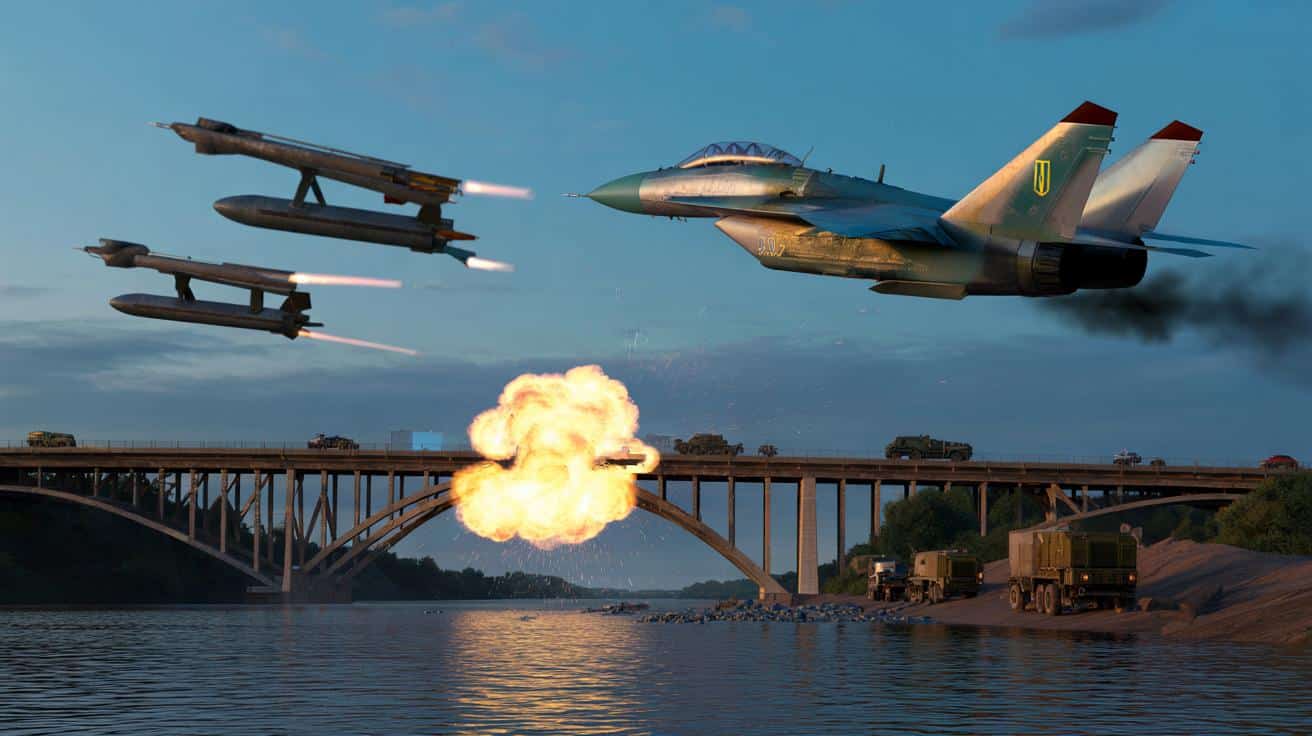
According to Soniashnyk, echoed by the specialist outlet Militarnyi, the bridge was hit by an upgraded Ukrainian MiG-29 fighter jet armed with two AASM “Hammer” precision-guided bombs made in France.
The Ukrainian general staff has not officially confirmed the strike, nor the use of the AASM, a typical posture when Kyiv wants to preserve operational ambiguity. But footage shared on Telegram shows a twin-tail jet – consistent with a MiG-29 silhouette – releasing two munitions that arc towards a bridge before a sharp double explosion.
The clip, filmed from a distance, appears to show the centre of the structure collapsing into the water or onto the riverbank. The Soniashnyk channel captioned the video with a sardonic message: Ukrainian ground forces “ordered a concert” while the air force “provided the fireworks”.
What is the AASM “Hammer” bomb?
The AASM (Armement Air-Sol Modulaire) is a modular air-to-ground weapon built by the French company Safran. It transforms a standard unguided bomb into a precision weapon by attaching guidance and propulsion kits to the front and rear.
➡️ The day I built a self-watering system from rubbish I never thought I’d keep
➡️ The science is in: this is the most efficient and economical way to heat your home
➡️ Ornithologists repeat it every year: this simple winter task can save baby birds
➡️ What is really the most efficient and energy‑saving space heater? Here’s the verdict
➡️ Germany pressing Belgium on frozen Russian assets
The AASM allows a fighter jet to hit fixed or moving targets from a significant stand-off distance, while staying away from dense air defences.
French forces have used the bomb extensively in overseas operations, and US observers have nicknamed it a “wonder weapon” for its accuracy and flexibility. Earlier this year, then-defence minister Sébastien Lecornu announced that France would supply Ukraine with around 50 AASM kits per month.
How the weapon works on Soviet-era aircraft
Integrating a French weapon onto a Soviet-designed MiG-29 is not straightforward. The aircraft’s original avionics were never built to talk to Western guidance kits.
According to defence analysts, Ukrainian engineers, with support from European partners, have re-wired some MiG-29s so they can communicate basic targeting data to Western munitions. This involves additional pylons, interface boxes and software tweaks inside the cockpit.
- The nose guidance kit steers the bomb using GPS, inertial sensors and sometimes laser cues.
- A rear-mounted rocket booster or propulsion unit extends range and lets the bomb glide or power itself towards the impact point.
- Different bomb bodies can be used, allowing various explosive weights depending on the mission.
With these modifications, a Ukrainian pilot can release the AASM from distance and then immediately turn away. The bomb continues towards pre-programmed coordinates, correcting its course in flight.
Why this bridge matters for the battlefield
Bridges in occupied territory carry more than trucks and armoured vehicles. They shape how fast an army can respond to breakthroughs or reinforce a threatened sector.
By hitting a key road bridge near Pokrovsk, Ukraine likely aims to:
- Disrupt the flow of ammunition and fuel to Russian assault units.
- Force Moscow’s troops to reroute through longer, less secure roads.
- Reduce the number of safe staging points near the contact line.
- Test and showcase the MiG-29/AASM combination for future deep strikes.
Previous hits had partially damaged the structure, creating potholes and slowing traffic. Reports now suggest a central span has been destroyed, requiring major engineering work or the construction of a temporary crossing.
French support and the politics of precision strikes
Paris has presented the delivery of AASM kits as a way to help Ukraine hold its ground without immediately escalating into the supply of long-range ballistic missiles. The bombs’ range is shorter than that of systems like Britain’s Storm Shadow cruise missile, but they still allow Ukrainian pilots to stay further from the front than traditional unguided bombs.
Each batch reportedly sent to Ukraine adds pressure on Russia’s logistics. Rail hubs, ammunition dumps and command posts that once seemed relatively secure behind the front line now face more frequent, accurate strikes from the air.
For Western capitals, such weapons let Ukraine hit meaningful targets while maintaining restrictions on very long-range attacks deep inside Russia.
The Kremlin, for its part, has condemned Western arms deliveries and framed every new capability, from tanks to guided munitions, as proof that NATO is waging a “proxy war”. Russian officials rarely comment on individual strikes, but state media often highlight the shooting down of missiles and bombs to project an image of control.
What could come next
If the Pokrovsk bridge strike used AASM bombs as claimed, the operation will likely not be the last of its kind. Once pilots gain confidence with a new weapon, they tend to seek other high-value targets.
Likely candidates include:
- Bridges across rivers used by Russian supply convoys.
- Fuel storage sites supporting armoured thrusts.
- Hardened command posts that are hard to reach with artillery.
- Air defence positions that shield Russian forward bases.
Each successful strike also helps Kyiv assess Russian responses: how quickly engineers deploy pontoon bridges, where new supply routes appear, and which air defence batteries switch on and reveal their positions.
Understanding “high-precision” strikes
The term “high-precision” is used often, but it has a specific military meaning. A weapon like the AASM is designed to land within a few metres of its intended target when given good coordinates. That level of accuracy allows smaller warheads to achieve structural effects that previously required heavy bombardment.
For a bridge, a near-perfect hit on a support pillar or central span can do more damage than several poorly aimed bombs hitting the roadway. The goal is not only to create a crater but to break the load-bearing structure, forcing lengthy repairs.
High-precision munitions turn each sortie into a carefully planned engineering problem: where to hit, with what weight, at what angle.
That is why these weapons are so coveted. A country with a limited number of aircraft and trained pilots, like Ukraine, cannot afford to run frequent low-yield missions. Precision lets each flight count.
Risks, countermeasures and an evolving air war
Using guided bombs is far from risk-free. To release an AASM, a MiG-29 still needs to fly relatively close to the front, within reach of Russian long-range surface-to-air missiles and fighter patrols.
Both sides constantly adjust tactics:
- Ukraine tends to fly low to avoid radar, then briefly climb to release guided bombs.
- Russia moves its air defence systems and decoys to confuse Ukrainian targeting.
- Electronic warfare units attempt to jam GPS signals and degrade bomb guidance.
Future strikes could trigger a technological race: improved guidance kits on Ukrainian munitions faced by stronger jamming and more layered air defence on the Russian side. Bridges and logistics nodes will remain at the heart of that contest, because they amplify every gain and every loss along the front line.