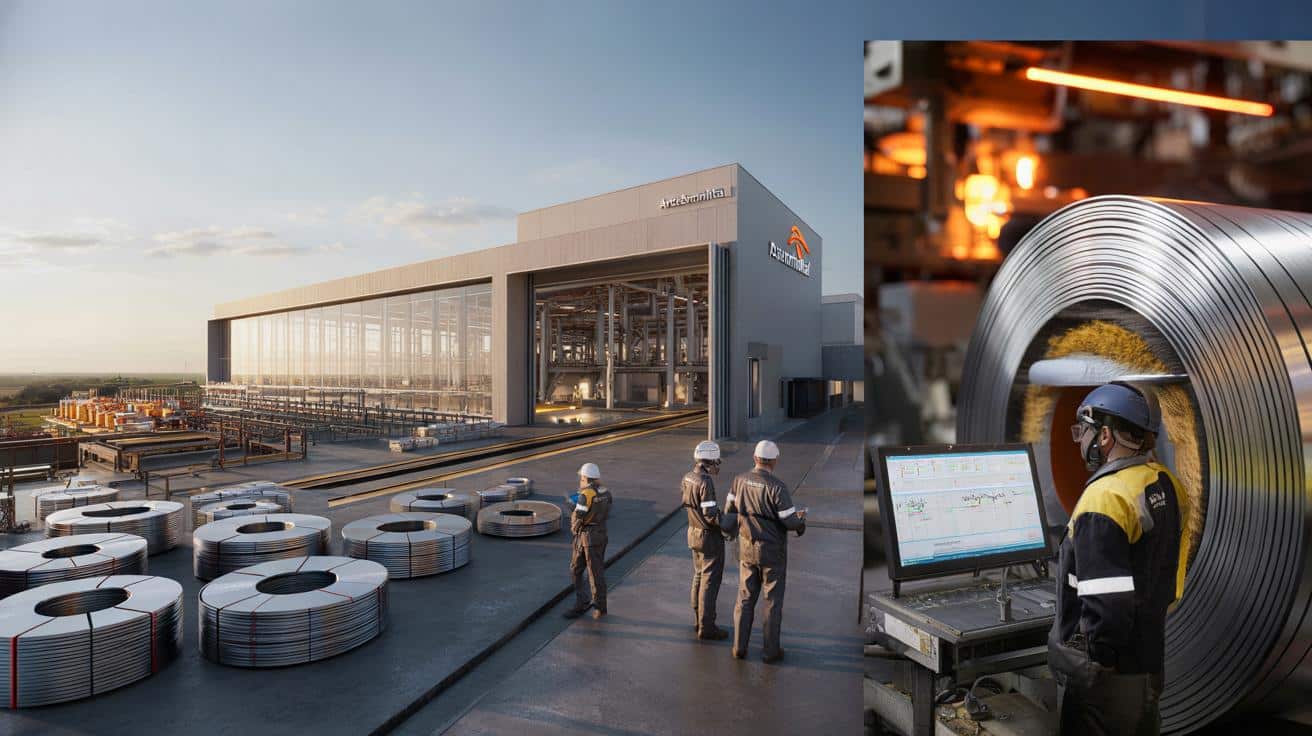
On an industrial site at Mardyck, steel giant ArcelorMittal is pouring hundreds of millions into a material most drivers have never heard of, but every future electric motor will need: electrical steel.
A €500 million wager on Europe’s electric future
ArcelorMittal has launched a new electrical steel production line at Mardyck, in the Hauts-de-France region, for a total investment of €500 million. For the group, this is its largest industrial commitment in Europe in a decade.
Three production lines are expected to be in operation by the end of 2025, rising to five by 2027. The goal is clear: supply the metallic core of Europe’s electric motors, from cars to wind turbines.
A single French site is being built to supply the steel that sits at the heart of millions of future electric motors.
This bet is not only about technology. It is also about geography. By installing this capacity in northern France, the group positions itself closer to European automakers and electrical equipment manufacturers determined to shorten supply chains after years of disruption.
From steel behemoth to specialist in electrical grades
ArcelorMittal, born in 2006 from the merger of European steelmaker Arcelor and Mittal Steel, has long symbolised classic heavy industry: blast furnaces, slabs, coils. Over time, it has had to adapt to Asian competition, climate pressure and the rise of electric mobility.
The Mardyck project fits into that shift. It moves a slice of the group’s European activity away from bulk steel and towards high-value, technically demanding products with a clear role in the energy transition.
What electrical steel actually is
Thin, precise and magnetic, not just heavy metal
Electrical steel is nothing like the thick beams used in skyscrapers or bridges. It comes as ultra-thin, precisely treated strips, designed to guide magnetic fields while minimising energy losses.
These strips are stacked to form the core of motors, generators and transformers. Their job is simple to explain and hard to achieve: channel magnetism efficiently, turn electrical energy into motion, or motion into electricity, with as little waste as possible.
➡️ Germany pressing Belgium on frozen Russian assets
➡️ The day I built a self-watering system from rubbish I never thought I’d keep
➡️ “I’m 65 and felt tired after short walks”: the breathing pattern that limited endurance
➡️ Help birds survive the coldest nights: this is the one food that brings their warmth back
➡️ A grave rewrites history: the first human gold jewellery was here
➡️ UK and Australia deploy Typhoons and F-35 fighters to U.S. for Red Flag 26 combat training
Electrical steel does not generate electricity; it allows systems to lose less of it at every turn.
Without this material, high-efficiency motors for electric cars, factory machines or wind turbines would struggle to reach the performance targets regulators and consumers now expect.
An integrated production line at Mardyck
From raw coils to motor-ready strips
The new unit at Mardyck is designed as a fully integrated chain, turning steel coils into finished electrical steel products tailored to manufacturers’ specifications.
In its first phase, three core lines are being installed:
- a preparation line,
- a continuous annealing and coating line,
- a slitting line.
Each stage shapes the final performance of the material. Annealing changes the internal structure of the steel to give it the right magnetic behaviour. Coating provides electrical insulation between layers. Slitting cuts the strip to the exact widths demanded by motor and transformer makers.
At the end of the process, hundreds or thousands of these thin sheets are stacked to build rotors and stators, the static and rotating parts of electric motors.
French capacity for a European market
Mardyck does not stand alone. It complements ArcelorMittal’s site at Saint-Chély-d’Apcher, in southern France. Together, these two locations will give the group a European electrical steel capacity of around 295,000 tonnes per year, all produced in France.
For Mardyck alone, the target is 155,000 tonnes annually. According to current price ranges, this output could represent between €153 million and €204 million per year in sales.
| Site | Product | Annual capacity (tonnes) |
|---|---|---|
| Mardyck (Hauts-de-France) | Electrical steel for motors, generators, transformers | 155,000 |
| Saint-Chély-d’Apcher (Lozère) | Electrical steel, existing expertise | 140,000 (approx.) |
| Total France (ArcelorMittal) | Electrical steel | 295,000 |
Why thinner steel means longer range
A quiet amplifier of performance
For electric vehicles, the thickness of the steel sheets matters a lot. In motors, the steel used can be as thin as 0.2 millimetres, up to around 0.35 millimetres for heavy-duty industrial motors and generators.
The physics is straightforward:
- Thinner steel reduces magnetic losses inside the motor.
- Lower losses increase the motor’s efficiency.
- Higher efficiency boosts vehicle range or cuts electricity consumption.
Across a car’s lifetime, a few percentage points of efficiency mean significant savings in energy and operating costs. At the scale of a fleet, or an industrial site full of machines and pumps, this effect becomes huge for both grid operators and energy bills.
A major construction project in a historic steel region
The transformation of the Mardyck site has been a construction project of its own. Up to 400 people were involved at peak, from design engineers to contractors installing and testing the new lines. Around 300 external companies took part, mixing refurbishment of existing halls with new buildings and advanced equipment.
For the group, the start-up sequence is seen as a test of its ability to deliver complex projects on tight schedules. The region around Dunkirk, long associated with traditional steelmaking, now hosts a plant geared towards the energy transition.
The human side of a strategic material
Behind the technology sits a growing team. Around 175 staff are already dedicated to the electrical steel activity across Mardyck and nearby Dunkirk. They run the lines, maintain the machinery, monitor quality, manage energy use and oversee digital tools.
Once the second phase is completed, around 200 people are expected to work solely on this electrical steel stream. Many have been recruited internally; others have joined from outside. More than 12,000 hours of training have already been delivered, including sessions at Saint-Chély-d’Apcher, where experienced teams passed on their know‑how.
Operational responsibility for the new lines has been entrusted to a department led by Gaëlle Le Papillon, underlining the company’s effort to align industrial leadership with new skills in automation, data and energy efficiency.
A building block for European electromobility
Anchoring value chains in France
By concentrating its European electrical steel production in France, ArcelorMittal sends a signal that goes beyond its own balance sheet. European policymakers want more of the electric vehicle and grid supply chain on home soil. Electrical steel sits at a pivotal point in that chain.
The Hauts-de-France region is already attracting battery plants, assembly sites and suppliers focused on electric mobility. In this puzzle, Mardyck adds a critical piece: the magnetic core that makes every motor or transformer more efficient.
Without reliable supplies of electrical steel, plans for European-made electric cars and smart grids would run into a hard physical limit.
Public support and strategic timing
The project has received €25 million from the French state through the France 2030 programme, which backs industrial capacities seen as strategic for the energy transition.
Timing also aligns with global market trends. The electrical steel market was valued at around $38.2 billion in 2023, roughly €32 billion. Forecasts indicate it could reach about €57 billion by 2032, driven by electrified transport and modernised power networks.
A market pulled by smart grids and massive electrification
Electric vehicles grab the headlines, but they are only part of the story. Smart grids and next-generation power infrastructure are becoming major consumers of high-grade electrical steel.
New transformers, advanced meters and grid equipment must handle more frequent load changes, higher levels of renewable energy and stricter efficiency regulations. They use specialised electrical steels that can cope with fluctuating conditions while limiting magnetic losses.
As grid operators upgrade ageing infrastructure, demand for these steels does not follow a short-lived fashion. It responds to a hard requirement: move larger volumes of electricity, more often, while wasting less energy as heat.
How electrical steel works inside a motor or transformer
For readers not familiar with the jargon, a few concepts help make sense of this industry.
- Magnetic losses are energy losses that occur when steel is magnetised and demagnetised repeatedly in a motor or transformer. High-quality electrical steel is engineered to reduce these losses.
- Grain-oriented vs non-grain-oriented steels serve different roles. Grain-oriented grades are optimised for transformers, which use a constant magnetic direction. Non-grain-oriented steels suit motors, where the magnetic field rotates.
- Coatings on the steel act as insulation between sheets. They prevent short circuits and help direct magnetic fields properly.
In a typical electric motor, the rotor and stator are built by stacking and punching thousands of sheets. Small changes in thickness or coating quality can shift the motor’s final efficiency by several percentage points.
Risks, opportunities and what could shift the balance
A plant of this size faces clear risks. The pace of electric vehicle adoption, regulatory changes and competition from Asian steelmakers will all influence its long-term profitability. Any delay in grid investment could also affect demand for high-grade steels.
On the other hand, the combination of climate targets, bans on new combustion engine cars in Europe and pressure to cut energy losses across industrial equipment all push in the same direction. If these trends hold, plants like Mardyck could see steady demand, while customers benefit from a European source less exposed to geopolitical shocks.
For now, northern France is betting that inside every future electric motor, there will be a thin, precisely crafted slice of steel rolled a few kilometres from the North Sea.